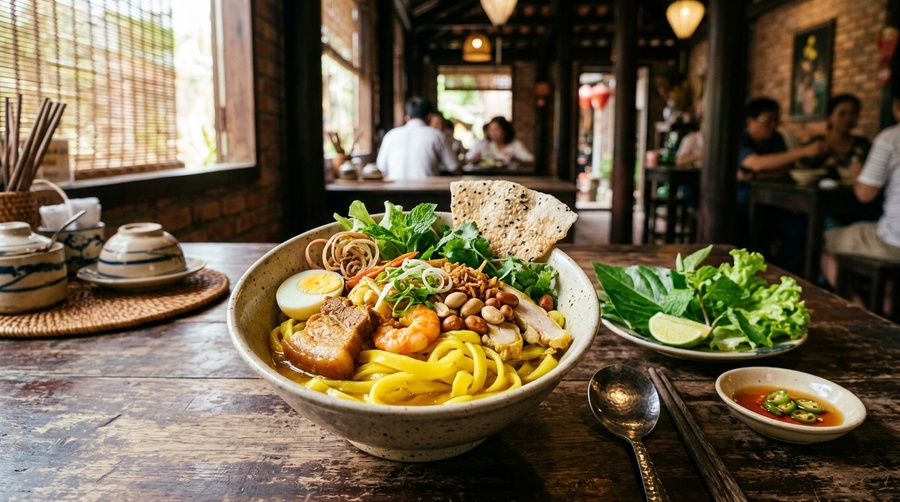
What is Mi Quang
The name of the dish consists of two parts:
- mì — noodles;
- Quảng — a shortened reference to the Quảng Nam region.
Mi Quang can be translated as "Quảng-style noodles."
Despite the word mì, the classic dish is usually made with rice noodles rather than wheat noodles. They are wide, flat, and most often white or yellow in color.
A single bowl typically contains:
- noodles;
- meat, fish, or seafood;
- a small amount of concentrated broth;
- fresh herbs;
- bean sprouts;
- crushed peanuts;
- a rice cracker;
- onions and spices.
How Mi Quang Differs from Soup
Mi Quang is served in a deep bowl, but the broth should not completely cover the noodles.
Usually, only a few spoonfuls of liquid are added. It stays at the bottom and acts more like a rich gravy than a full soup broth.
Before eating, the noodles are mixed with the meat, herbs, and sauce. As a result, every strand absorbs the flavor of the spices and meat juices.
If there is too much liquid in the bowl, the dish can lose its characteristic texture and become like an ordinary noodle soup.
What Noodles Are Used
The noodles are called sợi mì Quảng — "Mi Quang threads."
They are distinguished by the following features:
- wide;
- flat;
- soft, but not mushy;
- slightly chewy;
- good at holding sauce.
The noodles are made from rice flour. The batter is spread in a thin layer, steamed, and then cut into wide strips.
Sometimes turmeric is added to the batter, giving the noodles a yellow color. In other establishments, white noodles are used, and the color of the dish comes from the broth itself.
Why the Noodles Can Be Yellow
The yellow tint of the noodles or sauce is often created by turmeric, known as nghệ.
It is added to the batter, marinade, or oil used to brown the meat. Turmeric gives the dish a warm color and a mild earthy aroma.
In some versions, the color is also created using annatto seed oil, known as dầu điều.
Bright yellow noodles are not a mandatory sign of authentic Mi Quang. Both white and yellow varieties can be found across different areas of Quảng Nam province.
How the Broth Is Prepared
The broth for Mi Quang must be concentrated. It is prepared in a small volume, often at the same time as the meat.
Ingredients may include:
- pork or chicken bones;
- meat juices;
- shrimp broth;
- fish sauce (nước mắm);
- turmeric;
- garlic;
- shallots;
- chili;
- sugar;
- black pepper;
- annatto oil;
- peanut or vegetable oil.
The meat is first marinated and pan-fried, then water or broth is added and it is simmered until tender. The resulting liquid is used to dress the noodles.
The flavor should be rich, savory, slightly sweet, and spiced.
Fresh Herbs
Mi Quang is always served with fresh herbs, known as rau sống.
The selection may include:
- leaf lettuce (xà lách);
- mint;
- cilantro (coriander);
- basil;
- perilla (tía tô);
- Vietnamese balm (kinh giới);
- green onions;
- bean sprouts (giá đỗ);
- thinly sliced banana blossom (bắp chuối).
The herbs are placed at the bottom or on top of the noodles. They add freshness and balance out the rich broth.
Peanuts
Crushed roasted peanuts are called đậu phộng rang or lạc rang.
In central and southern Vietnam, the word đậu phộng is used more frequently.
The peanuts are sprinkled on top. They add a sweetish aroma and a crunchy texture.
This ingredient is considered one of the defining characteristics of Mi Quang.
Rice Crackers
The dish is served with a rice cracker called bánh tráng nướng.
This is a thin rice wafer toasted until crispy. It is broken apart by hand and added to the bowl in small pieces.
The cracker can be:
- eaten on its own;
- dipped into the broth;
- crumbled over the noodles;
- used instead of a spoon for the meat and herbs.
It adds an important contrast between the soft noodles and the crunchy elements.
What Condiments Are Served
The table usually features:
- fresh chili (ớt);
- chili sauce (tương ớt);
- fish sauce (nước mắm);
- lime;
- pickled garlic;
- black pepper;
- extra peanuts.
Some establishments serve small green chili peppers from central Vietnam. They can be very spicy, so it is best to add them in small amounts.
Varieties of Mi Quang
There are many versions of the dish. They differ in their main meat or seafood, broth composition, and additional ingredients.
Chicken Mi Quang
Mì Quảng gà is one of the most common varieties.
The word gà means "chicken."
The chicken is cut into small pieces, sometimes with bones, marinated with fish sauce, turmeric, onions, and pepper, and then stewed.
The broth turns out rich, but not too greasy. The bowl may contain:
- pieces of chicken;
- quail eggs;
- peanuts;
- herbs;
- a rice cracker.
Bone-in chicken has a more pronounced flavor, but it must be eaten carefully.
Pork and Shrimp Mi Quang
Mì Quảng tôm thịt is a classic combination of shrimp and pork.
The words:
- tôm — shrimp;
- thịt — meat.
Usually, slices of pork and whole shrimp (in or out of their shells) are used. The ingredients are stewed together in a spiced broth.
This version combines the sweetness of seafood with the richness of pork.
Pork Mi Quang
Mì Quảng thịt heo is prepared with pork.
The following cuts may be used for the dish:
- belly;
- shoulder;
- ribs;
- pork neck;
- meat with a small amount of fat.
The pork is marinated, pan-fried, and stewed. The sauce turns out thick and slightly sweet.
Rib Mi Quang
Mì Quảng sườn is a version with pork ribs.
The word sườn means "ribs."
The meat is simmered for a long time until tender. The broth becomes especially rich thanks to the bones.
The bowl may contain fairly large pieces of ribs, which are easier to eat separately.
Beef Mi Quang
Mì Quảng bò is prepared with beef.
The beef is quickly pan-fried or stewed with spices. This version has a more pronounced meaty flavor and may be less sweet than the pork version.
It is less common than chicken or shrimp-pork Mi Quang, but popular in modern cafes.
Fish Mi Quang
Mì Quảng cá is a fish-based version.
The word cá means "fish."
The dish uses saltwater or freshwater fish with firm flesh. It is stewed with turmeric, onions, and spices.
In different regions, you can find versions with:
- snakehead fish;
- tuna;
- mackerel;
- other local fish.
The fish may contain small bones, so eat with caution.
Snakehead Fish Mi Quang
Mì Quảng cá lóc is prepared with snakehead fish.
This freshwater fish has firm white flesh and holds its shape well after stewing.
The broth is less greasy than the meat versions, but retains a rich flavor thanks to the spices and fish sauce.
Eel Mi Quang
Mì Quảng lươn is an eel version.
The word lươn means "eel."
Eel gives the sauce richness and a slightly sweet taste. It can be stewed in pieces or pre-fried.
This variation is not found everywhere and is often considered a regional or restaurant specialty.
Frog Mi Quang
Mì Quảng ếch is a popular modern variety featuring frog legs.
The word ếch means "frog."
The frog meat is stewed with turmeric, lemongrass, onions, and chili. In texture, it resembles chicken, but has a more delicate flavor.
Sometimes the noodles and stewed frog are served in separate bowls.
Seafood Mi Quang
Mì Quảng hải sản is prepared with seafood.
The ingredients may include:
- shrimp;
- squid;
- fish;
- clams;
- octopus.
This option is particularly common in Đà Nẵng and coastal tourist areas.
Crab Mi Quang
Mì Quảng cua is a crab version.
The word cua means "crab."
Crab meat can be used on its own or together with pork and shrimp. The sauce turns out sweeter and richer with seafood flavor.
Mi Quang with Egg
Different versions of the dish may include:
- chicken egg (trứng gà);
- quail eggs (trứng cút).
An egg is not a mandatory base for a separate variety, but it is often included in a full portion.
Quail eggs are boiled and stewed together with the meat so they absorb the flavor of the sauce.
Special Mixed Mi Quang
Mì Quảng thập cẩm is a mixed portion with several types of meat or seafood.
The words thập cẩm mean "assorted" or "mixed."
The bowl may contain:
- chicken;
- pork;
- shrimp;
- egg;
- Vietnamese meatloaf/sausage;
- ribs.
The composition depends on the establishment.
Special Portion
Mì Quảng đặc biệt is a special or upgraded portion.
The word đặc biệt means "special."
It may include more meat, multiple toppings, extra eggs, and a large rice cracker.
Vegetarian Mi Quang
Mì Quảng chay is the vegetarian version.
The word chay means "vegetarian" or "vegan."
Meat and seafood are replaced with:
- tofu;
- mushrooms;
- vegetables;
- seitan;
- plant-based cutlets.
The broth is made from mushrooms, vegetables, and soy sauce.
Strict vegans should check whether fish sauce, eggs, or animal-based broth are used.
"Dry" Mi Quang
Sometimes you may encounter the name mì Quảng khô.
The word khô means "dry."
This portion includes very little liquid or has the sauce served on the side. However, classic Mi Quang already contains little broth, so the line between the regular and dry versions can be subjective.
How to Properly Eat Mi Quang
Before eating, the dish must be thoroughly mixed.
The sauce is at the bottom of the bowl, while the herbs and peanuts may be sitting on top. After mixing, the noodles become evenly coated with the broth.
A convenient order:
- taste a little of the broth;
- add lime juice to taste;
- add fresh chili or chili sauce;
- break apart the rice cracker;
- add a portion of the cracker to the bowl;
- mix the noodles well;
- eat with chopsticks, combining noodles, meat, and herbs.
Do not add a lot of fish sauce right away. The broth may already be sufficiently salty.
It is best to leave a portion of the cracker dry to keep it crunchy until the end of the meal.
How Mi Quang Differs from Cao Lau
Mi Quang is often compared to cao lầu because both dishes originate from central Vietnam and contain a small amount of liquid.
The main differences:
Mi Quang:
- associated with the entire Quảng Nam province and Đà Nẵng;
- made with wide rice noodles;
- can include chicken, pork, shrimp, fish, and other foods;
- contains a small amount of concentrated broth;
- served with peanuts;
- accompanied by a rice cracker.
Cao Lau:
- primarily associated with Hội An;
- made with denser and chewier special noodles;
- most often served with pork;
- contains a dark meat sauce;
- includes crunchy dough pieces;
- usually not topped with a large amount of peanuts.
How Mi Quang Differs from Bun Bo Hue
Bún bò Huế is a full spicy soup with a large amount of broth.
Mi Quang has significantly less liquid.
In addition:
- bún bò Huế uses thick round noodles;
- Mi Quang uses wide flat noodles;
- bún bò Huế has a pronounced lemongrass aroma;
- Mi Quang is often prepared with chicken, shrimp, or fish;
- Mi Quang includes peanuts and rice crackers.
How to Order Mi Quang
You may encounter the following names on the menu:
- mì Quảng — Mi Quang;
- mì Quảng gà — with chicken;
- mì Quảng tôm thịt — with shrimp and pork;
- mì Quảng thịt heo — with pork;
- mì Quảng sườn — with pork ribs;
- mì Quảng bò — with beef;
- mì Quảng cá — with fish;
- mì Quảng cá lóc — with snakehead fish;
- mì Quảng ếch — with frog;
- mì Quảng hải sản — with seafood;
- mì Quảng thập cẩm — mixed portion;
- mì Quảng đặc biệt — special portion;
- mì Quảng chay — vegetarian version;
- không cay — not spicy;
- ít cay — mildly spicy;
- không đậu phộng — without peanuts;
- thêm rau — add extra herbs;
- thêm mì — add extra noodles;
- thêm bánh tráng — add extra rice cracker.
The phrase một tô mì Quảng means "one bowl of Mi Quang."
When is the Best Time to Eat Mi Quang
The dish is eaten for breakfast, lunch, and dinner.
In the morning, it is served in small family eateries. At lunch, Mi Quang is chosen as a hearty, but not too heavy, meal. In the evening, it is easy to find in markets and restaurants across central Vietnam.
It is best to arrive during peak serving hours when the noodles, herbs, and meat have not been sitting ready for long.
Where is the Best Place to Try Mi Quang
The best regions to experience the dish:
- Quảng Nam;
- Đà Nẵng;
- Hội An;
- towns and villages of central Vietnam.
In a good establishment:
- the noodles remain chewy;
- there is little broth;
- the herbs look fresh;
- the peanuts retain their crunch;
- the rice cracker is not soggy;
- the meat is tender;
- the flavor is rich, but not excessively salty;
- the dish is actively ordered by locals.
If the bowl is completely filled with liquid, it may be an adapted version.
What Tourists Should Keep in Mind
Classic Mi Quang may contain pork, chicken, shrimp, fish, eggs, peanuts, and fish sauce.
People with a peanut allergy should say in advance:
Không đậu phộng — without peanuts.
In case of a seafood allergy, it is necessary to clarify not only the toppings, but also the broth base.
Small bones may be found in chicken, fish, and rib variants.
Fresh herbs and bean sprouts are often uncooked, so it is best to choose places with high customer turnover and clean kitchens.
The dish itself is usually moderately spicy, but the chili sauce in central Vietnam can be very fiery.
Why You Should Try Mi Quang
Mi Quang captures the character of central Vietnamese cuisine well: vibrant, spicy, and built on a combination of different textures.
In a single bowl, soft noodles, concentrated broth, juicy meat or seafood, fresh herbs, crunchy peanuts, and a rice cracker come together.
For a first introduction, it is best to choose chicken Mi Quang (mì Quảng gà) or the classic shrimp and pork combination mì Quảng tôm thịt. Before eating, mix the dish well, but leave a portion of the rice cracker dry to preserve its crunch.