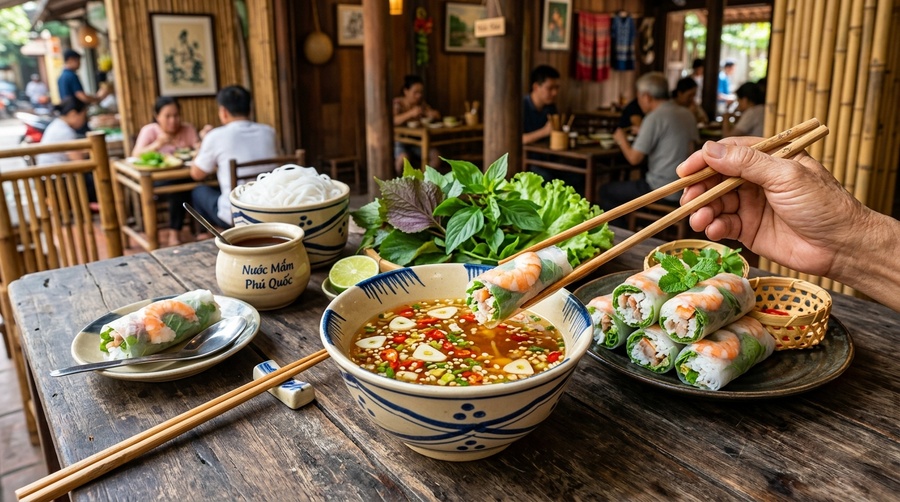
What is Nước Mắm
Nước mắm is a clear, liquid seasoning obtained through the long-term fermentation of fish and salt.
The name consists of two parts:
- nước — water or liquid;
- mắm — fermented fish or seafood product.
Small marine fish, especially anchovies, are typically used for production. The fish are layered with salt in large containers and left for several months or longer.
During fermentation, proteins gradually break down, forming a dark amber-colored liquid with high salinity and a rich umami flavor.
What is Nước Chấm
Nước chấm literally means "dipping sauce."
The word chấm translates to "to dip" or "to dab."
This is not a single strictly defined recipe, but rather a general term for prepared table sauces. The most famous version is based on fish sauce, but nước chấm can also be soy-, peanut-, or fermentation-based.
Classic fish sauce-based nước chấm typically contains:
- nước mắm;
- water;
- sugar;
- lime juice or vinegar;
- garlic;
- fresh chili;
- sometimes pickled vegetables.
This sauce is significantly milder and less salty than pure fish sauce.
The Main Difference Between Nước Mắm and Nước Chấm
The difference can be stated simply:
- nước mắm — concentrated fish sauce;
- nước chấm — prepared dipping sauce.
Nước mắm is used as:
- a seasoning;
- an ingredient;
- a marinade base;
- a source of salt and umami;
- a base for other sauces.
Nước chấm is used as:
- a ready-made accompaniment to a dish;
- a sauce for rolls;
- a dressing for noodles;
- a sauce for meat and fish;
- a condiment served in a separate small bowl.
Pure nước mắm is usually too salty to pour heavily over food. Nước chấm is specially diluted and balanced with sugar and acid.
How Fish Sauce is Produced
The main ingredients of traditional fish sauce are:
- fresh fish;
- sea salt.
The fish is mixed with salt and placed in wooden barrels, ceramic vessels, or large tanks.
The mixture ferments under the action of the fish's own enzymes. In the process, a liquid is formed, which is collected, filtered, and sometimes returned to the container for further aging.
Production can take anywhere from a few months to a year or more.
High-quality sauce has:
- a clear amber color;
- a pronounced, but not putrid aroma;
- high salinity;
- a deep umami flavor;
- a light natural sweetness.
What Kind of Fish is Used
Fish sauce is most frequently made from anchovies, known as cá cơm.
This small fish is suitable due to its high protein content and ability to ferment quickly.
They may also use:
- sardines;
- mackerel;
- other small marine fish;
- mixed catches.
Anchovy sauce is considered the most classic.
Salt
Salt plays multiple roles at once:
- inhibits the growth of unwanted microorganisms;
- preserves the fish;
- initiates proper fermentation;
- shapes the flavor;
- helps extract liquid.
For a quality product, the purity of the salt, its origin, and the correct ratio to the fish are essential.
Too much salt makes fermentation slow and the taste harsh. Insufficient salt can lead to spoilage of the raw material.
The First Extraction
Particularly prized is the first-extraction fish sauce, nước mắm cốt or nước mắm nhĩ.
This is the liquid that naturally drains from the fermented mass without heavy dilution.
It is typically characterized by:
- high concentration;
- rich aroma;
- dark amber color;
- deep salinity;
- pronounced umami.
Such sauce is used in small portions and is often considered a higher-quality product.
What Độ Đạm Means
On fish sauce bottles, you may see the designation độ đạm.
It indicates the content of nitrogen associated with protein compounds and amino acids formed during fermentation.
A higher figure usually means a more concentrated product, but by itself, it does not guarantee a better taste.
One should also evaluate:
- ingredients;
- origin;
- aroma;
- clarity;
- production method;
- amount of added sugar and flavor enhancers.
Color of Fish Sauce
Nước mắm can range in hue from golden to dark amber.
The color depends on:
- the species of fish;
- the duration of fermentation;
- the amount of salt;
- temperature;
- production technology;
- degree of dilution.
An overly dark color does not always signify high quality, and a light sauce is not necessarily worse.
Aroma
Pure fish sauce possesses a strong, specific aroma.
To someone unaccustomed to fermented products, it may seem harsh. However, quality nước mắm should not smell like spoiled fish.
Its aroma is rather:
- salty;
- fermented;
- oceanic;
- rich;
- slightly caramelly.
After mixing with lime, sugar, garlic, and water, the scent becomes significantly milder.
How Classic Nước Chấm is Prepared
There is no universal recipe, but the basic formula includes:
- fish sauce;
- water;
- sugar;
- lime juice or vinegar;
- garlic;
- chili.
One common method:
- dissolve sugar in warm water;
- add fish sauce;
- pour in lime juice or vinegar;
- taste to check the balance;
- add minced garlic;
- add sliced chili;
- dilute with water if necessary.
A proper sauce should be simultaneously:
- salty;
- sweet;
- sour;
- slightly spicy;
- aromatic.
No single flavor should completely dominate.
Why the Mixing Order Matters
If all components are combined immediately, the sugar may not dissolve well.
It is more convenient to mix it with warm water first and then add the remaining ingredients.
Garlic and chili are often added at the end. In a properly prepared sauce, small pieces may float on the surface.
Lime or Vinegar
Acidity is created by:
- lime juice (nước cốt chanh);
- rice vinegar;
- regular vinegar;
- sometimes tamarind.
Lime provides a fresh citrus aroma. Vinegar creates a cleaner and sharper acidity.
The choice depends on the dish and the regional recipe.
Sugar
In southern Vietnam, nước chấm is typically made noticeably sweet.
They use:
- white sugar;
- palm sugar;
- cane sugar;
- sometimes coconut water.
Sugar not only sweetens the sauce but also softens the salinity of the fish sauce.
Garlic
Garlic is called tỏi.
It is finely chopped or crushed. It imparts spiciness and a fresh aroma to the sauce.
Garlic is not always present in all versions. A simpler sauce without it may be served with certain fish dishes.
Chili
Chili pepper is called ớt.
The quantity is adjusted to taste. Chili can be:
- fresh;
- chopped;
- crushed with garlic;
- added in whole rounds;
- replaced with hot sauce.
For a non-spicy version, you can say:
Không ớt — without chili.
Pickled Vegetables
Thinly sliced items may be added to the sauce:
- carrot;
- daikon;
- green papaya;
- kohlrabi;
- cucumber.
Such vegetables create a crunch and absorb the sweet-and-sour dressing.
They are especially common in sauces for bún chả, fried rolls, and rice pancakes.
Main Varieties of Nước Mắm
Nước Mắm Nhĩ
Nước mắm nhĩ is a concentrated fish sauce from the first natural extraction.
It is used in small quantities due to its high salinity and rich flavor.
Nước Mắm Cốt
Nước mắm cốt is the concentrated base of fish sauce.
The word cốt means "base," "concentrate," or "essence."
Nước Mắm Pha
Nước mắm pha is diluted or blended fish sauce.
The word pha means "to mix" or "to dilute."
This can be a simple sauce with water and sugar, or a full-fledged nước chấm.
Nước Mắm Ăn
Nước mắm ăn is fish sauce prepared for eating.
The word ăn means "to eat."
This name may refer to a pre-balanced table sauce that does not require additional dilution.
Nước Mắm Phú Quốc
Nước mắm Phú Quốc is fish sauce from Phú Quốc Island.
It is traditionally associated with the fermentation of anchovies in wooden barrels.
The sauce is known for its clear amber color and rich flavor.
Nước Mắm Phan Thiết
Nước mắm Phan Thiết is fish sauce from the Phan Thiết area.
This region is also known for its long tradition of fish processing and fermented sauce production.
Nước Mắm Cát Hải
Nước mắm Cát Hải is a northern regional fish sauce associated with the Cát Hải island district near Hải Phòng.
It may feature a more pronounced salinity and a less sweet taste compared to southern table sauces.
Varieties of Nước Chấm
Classic Sweet-and-Sour Nước Chấm
The most widespread variant is prepared from fish sauce, water, sugar, lime, garlic, and chili.
It is served with:
- gỏi cuốn;
- chả giò;
- nem rán;
- bánh xèo;
- bánh cuốn;
- bún thịt nướng;
- cơm tấm.
Nước Mắm Tỏi Ớt
Nước mắm tỏi ớt is fish sauce with garlic and chili.
The words mean:
- tỏi — garlic;
- ớt — chili.
Such a sauce can be either diluted or quite concentrated.
It is served with fried fish, seafood, meat, and rice.
Nước Mắm Chanh Ớt
Nước mắm chanh ớt is fish sauce with lime and chili.
It turns out more sour and fresh.
It pairs well with seafood and boiled meat.
Nước Mắm Gừng
Nước mắm gừng is fish sauce with ginger.
The word gừng means "ginger."
Added to the sauce are:
- minced ginger;
- fish sauce;
- sugar;
- lime;
- garlic;
- chili.
It is frequently served with:
- duck;
- chicken;
- snails;
- fish;
- seafood.
Nước Mắm Keo
Nước mắm keo, or thick fish sauce, is prepared with a large amount of sugar.
It has a viscous consistency and can be used as a glaze or sauce for fried dishes.
Nước Mắm Me
Nước mắm me is fish sauce with tamarind.
The word me means "tamarind."
The sauce turns out:
- sour;
- sweet;
- salty;
- fruity.
It is served with fried fish, seafood, and snails.
Nước Mắm Khóm
Nước mắm khóm is prepared with pineapple.
In the south, pineapple is called khóm or thơm.
The fruit imparts sweetness and a light acidity to the sauce.
Nước Mắm Ớt Xanh
Nước mắm ớt xanh is fish sauce with green chili.
It is especially popular with seafood.
The sauce may contain:
- green chili;
- lime;
- sugar;
- garlic;
- fish sauce.
Nước Mắm Ớt Đỏ
Nước mắm ớt đỏ is a variant with red chili.
It generally looks brighter and can be sweeter than the green version.
Nước Mắm Sữa
Nước mắm sữa is a sweetish creamy sauce based on fish sauce and condensed milk or another dairy base.
This is a modern and less common version, more often found in author-driven establishments.
Other Dipping Sauces
The term nước chấm is not limited to fish sauce.
Nước Tương
Nước tương is soy sauce.
It is served with:
- vegetarian dishes;
- tofu;
- rolls;
- noodles;
- fried items.
It can be pure or mixed with sugar, garlic, and chili.
Tương Đậu Phộng
Tương đậu phộng is peanut sauce.
It is frequently served with fresh gỏi cuốn rolls.
Ingredients may include:
- peanuts;
- hoisin sauce;
- fermented soy;
- sugar;
- garlic;
- chili.
Mắm Nêm
Mắm nêm is a thick fermented sauce made from fish or anchovies.
It is significantly stronger and harsher than regular nước mắm.
Before serving, it is usually mixed with:
- pineapple;
- sugar;
- lime;
- garlic;
- chili.
Mắm nêm is especially often served with pork, rice paper, and central Vietnamese rolls.
Mắm Tôm
Mắm tôm is fermented shrimp paste.
It possesses a very strong aroma and thick consistency.
It is mixed with lime, sugar, chili, and sometimes hot oil.
Mắm tôm is served with:
- bún đậu mắm tôm;
- boiled pork;
- fried tofu;
- noodles;
- certain northern dishes.
Mắm Ruốc
Mắm ruốc is a fermented shrimp or krill paste, particularly characteristic of central Vietnam.
It is used in Huế cuisine and added to:
- bún bò Huế;
- cơm hến;
- stews;
- sauces.
Muối Tiêu Chanh
Muối tiêu chanh is a mixture of salt, black pepper, and lime.
This is not a liquid fish sauce, but it also functions as a condiment for dipping.
It is served with:
- chicken;
- seafood;
- boiled eggs;
- fruit;
- meat.
Muối Ớt Xanh
Muối ớt xanh is a sauce or seasoning made from salt, green chili, and lime.
It is especially popular with seafood.
Regional Characteristics
Southern Vietnam
In the south, nước chấm is typically:
- sweeter;
- milder;
- contains more water;
- frequently includes garlic and chili;
- may contain pickled vegetables.
Such sauces pair well with cơm tấm, bánh xèo, and bún thịt nướng.
Central Vietnam
In the central regions, sauces are often:
- saltier;
- spicier;
- thicker;
- contain fermented pastes;
- have a more pronounced flavor.
Mắm nêm and mắm ruốc are especially widespread here.
Northern Vietnam
In the north, nước chấm is typically:
- less sweet;
- more sour;
- moderately diluted;
- may contain vinegar instead of lime;
- frequently includes carrot or kohlrabi.
Such a sauce is typical for nem rán and bún chả.
Which Dishes are Served with Nước Chấm
Gỏi Cuốn
Fresh gỏi cuốn rolls can be served with fish, peanut, or fermented sauce.
Classic fish sauce nước chấm is especially suited for rolls with shrimp and pork.
Chả Giò and Nem Rán
Fried chả giò and nem rán rolls are dipped in sweet-and-sour fish sauce.
The acidity and fresh herbs balance the greasiness of the fried wrapper.
Bánh Xèo
Crispy bánh xèo pancakes are wrapped in greens and rice paper, then dipped in sweetish nước chấm.
Bánh Cuốn
Rice bánh cuốn rolls are often drizzled with light fish sauce or served with it in a separate small bowl.
Bún Chả
In bún chả, the sauce simultaneously serves as a dressing, a dipping broth, and part of the presentation.
It may contain pork and pickled vegetables.
Cơm Tấm
Sweet southern nước chấm is served with broken rice (cơm tấm).
It is poured in small amounts over the rice and meat.
Fish and Seafood
Fish is frequently served with a more concentrated fish sauce featuring chili, lime, or ginger.
Popular for seafood are:
- nước mắm chanh ớt;
- nước mắm ớt xanh;
- muối tiêu chanh.
How to Properly Use Nước Mắm
Pure fish sauce is added in small quantities.
It is used for:
- marinating meat;
- seasoning soups;
- braising fish;
- fried rice;
- noodles;
- salads;
- preparing sauces.
It is best added gradually. Fixing excessive salinity is difficult.
When heated, the aroma becomes milder and the flavor deeper.
Can You Pour Pure Fish Sauce Over Food?
Yes, but usually in small amounts.
Concentrated nước mắm may be served with:
- fish;
- boiled meat;
- rice;
- eggs;
- vegetables.
However, for rolls and most appetizers, diluted nước chấm is more frequently used.
How to Properly Eat Dishes with Nước Chấm
The sauce is usually served in a small individual or shared bowl.
The food is only partially dipped. You should not submerge crispy rolls or rice paper for long—they will quickly sog.
If the sauce is used with rice or noodles, it is added in small portions and mixed.
Before using, you can try a drop to evaluate:
- salinity;
- sweetness;
- acidity;
- spiciness.
Can You Drink Nước Chấm?
Usually, it is not drunk on its own.
However, in dishes like bún chả, the sauce is heavily diluted and effectively becomes part of the liquid base. It can be eaten with a spoon alongside noodles, meat, and vegetables.
Concentrated fish sauce should not be drunk due to its high salinity.
How Nước Mắm Differs from Soy Sauce
Nước Mắm:
- produced from fish;
- possesses a marine, fermented aroma;
- contains a pronounced umami flavor;
- usually clear and amber;
- unsuitable for vegetarians.
Soy Sauce:
- produced from soybeans;
- has a bean and malt aroma;
- usually darker;
- suitable for many vegetarian dishes;
- may contain wheat.
They sometimes substitute for each other, but the flavor of the dish changes noticeably.
How Nước Mắm Differs from Mắm Nêm
Nước mắm is a clear liquid obtained from fermented fish.
Mắm nêm is a thicker, cloudy, and more aromatic fermented sauce in which more fish particles may remain.
Mắm nêm is generally:
- stronger-smelling;
- thicker;
- saltier;
- served after mixing with pineapple and spices.
How Nước Mắm Differs from Mắm Tôm
Mắm tôm is made from shrimp or krill rather than fish.
It has a paste-like consistency, a purple-gray color, and a very strong aroma.
Nước mắm is significantly more liquid, clear, and versatile.
How Nước Chấm Differs from Sweet Chili Sauce
Sweet chili sauce is generally thick and prepared from sugar, vinegar, chili, and starch.
Nước chấm:
- is more liquid;
- frequently contains fish sauce;
- has an umami flavor;
- is less viscous;
- is typically prepared without starch.
How to Order and Recognize Sauce
The following names may be encountered on menus and at the table:
- nước mắm — fish sauce;
- nước chấm — dipping sauce;
- nước mắm pha — diluted fish sauce;
- nước mắm tỏi ớt — fish sauce with garlic and chili;
- nước mắm gừng — ginger sauce;
- nước mắm me — tamarind sauce;
- nước mắm chanh ớt — with lime and chili;
- nước tương — soy sauce;
- mắm nêm — fermented fish sauce;
- mắm tôm — shrimp paste;
- không cay — not spicy;
- không ớt — without chili;
- ít cay — slightly spicy;
- ít ngọt — less sweet;
- ít mặn — less salty;
- thêm nước chấm — add sauce;
- để riêng nước chấm — serve sauce separately;
- không nước mắm — without fish sauce.
The phrase thêm nước chấm means "add dipping sauce."
For separate service, you can say:
Nước chấm để riêng — sauce on the side.
Is Fish Sauce Suitable for Vegetarians?
Regular nước mắm is unsuitable for vegetarians and vegans because it is produced from fish.
The vegetarian substitute is called:
Nước mắm chay.
Despite the name, this is not real fish sauce. It is prepared from plant-based ingredients:
- soy;
- mushrooms;
- pineapple;
- seaweed;
- salt;
- sugar;
- fermented beans.
At a restaurant, it is not enough to ask for a dish without visible fish. Fish sauce may be present in the marinade, broth, and dressing.
How to Ask for Sauce Without Fish Sauce
You can say:
Không nước mắm — without fish sauce.
For the vegetarian option:
Nước chấm chay — vegetarian dipping sauce.
Is Fish Sauce Suitable for a Gluten-Free Diet?
Classic fish sauce made from fish and salt typically does not contain wheat.
However, industrial products may add:
- flavor enhancers;
- flavorings;
- caramel;
- sugar;
- other sauces.
During a strict diet, it is necessary to check the ingredients of a specific bottle.
Soy sauce, which may be served instead of fish sauce, frequently contains wheat.
How to Choose Fish Sauce
When purchasing, you should pay attention to:
- a short ingredient list;
- specification of the fish species;
- origin;
- clarity;
- absence of sediment, unless intended by the product type;
- concentration;
- amount of sugar;
- absence of an excessive number of flavorings.
For cooking, a universal fish sauce of medium concentration will do.
For serving neat or preparing quality nước chấm, you can choose a more aromatic first-extraction sauce.
How to Store Fish Sauce
An unopened bottle should be stored in a cool, dark place.
After opening, fish sauce generally remains stable due to its high salinity. However, to preserve the aroma, it should be:
- tightly closed;
- protected from direct sunlight;
- kept away from heat sources;
- used with a clean spoon.
Prepared nước chấm keeps for significantly less time, especially if it contains fresh garlic, lime, and chili. It is best kept in the refrigerator and used within a short period.
What Tourists Should Consider
Nước mắm and nước chấm may contain:
- fish;
- anchovies;
- sugar;
- garlic;
- chili;
- lime;
- vinegar;
- glutamate;
- other fermented products.
If you have a fish allergy, you need to clarify the ingredients not only of the sauce on the table, but of the dish itself. Fish sauce is frequently used in marinades and broths.
Nước chấm can look almost transparent, so the presence of fish sauce is not always obvious.
The sauce can be quite sweet, especially in southern Vietnam.
Concentrated nước mắm contains a lot of salt, so it is added in small amounts.
Why Nước Mắm and Nước Chấm Are Worth Trying
Nước mắm is one of the foundational flavor elements of Vietnamese cuisine. Without it, fully understanding the taste of many soups, salads, meat dishes, rolls, and rice noodles is impossible.
Pure fish sauce provides salinity and umami, while nước chấm demonstrates how Vietnamese cuisine combines opposing flavors: salty fish sauce, sour lime, sweet sugar, spicy chili, and aromatic garlic.
For a first introduction, it is best to try mild sweet-and-sour nước chấm with gỏi cuốn, chả giò, or bánh xèo. Afterward, you can appreciate more concentrated variants: nước mắm gừng with duck or seafood, and the rich nước mắm nhĩ as part of traditional dishes.