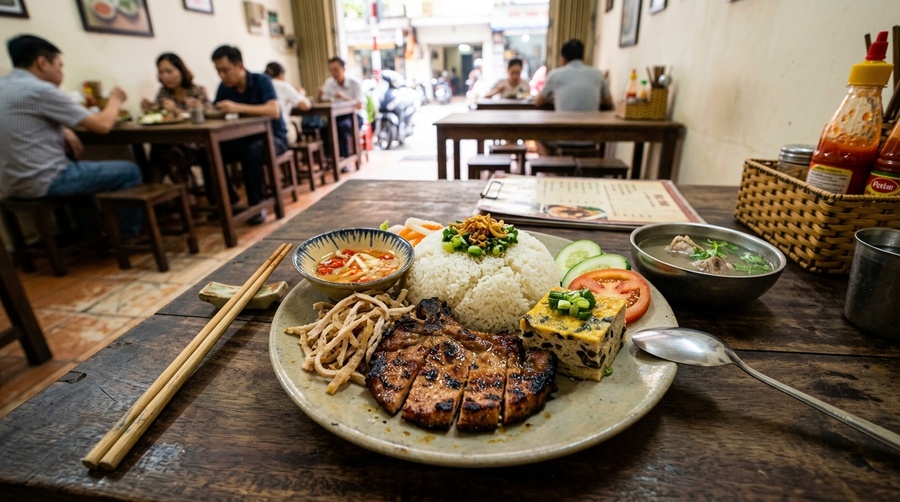
What is cơm tấm
Cơm tấm is a dish made of broken rice with meat and various toppings.
A classic portion usually includes:
- broken rice;
- a grilled pork chop;
- an egg meatloaf;
- thin strips of pork skin;
- a fried egg;
- pickled vegetables;
- fresh cucumber and tomato;
- scallion oil;
- fish sauce.
It is not necessary to order all components at once. On the menu, cơm tấm is often assembled like a constructor: the diner chooses the rice and one or more toppings.
The most famous complete option is called cơm tấm sườn bì chả. It includes a pork chop, pork skin, and meatloaf.
What the word "tấm" means
The word tấm refers to broken rice grains that form during the cleaning and polishing of rice.
Previously, large whole grains were sold, while small fragments were left for home consumption. Such rice was more affordable, cooked faster, and paired well with simple meat and vegetable additions.
Over time, broken rice ceased to be perceived solely as a cheap substitute for regular rice. Its special texture became the defining feature of an independent dish.
In English, cơm tấm is often called broken rice.
How broken rice differs from regular rice
Broken rice consists of small grain fragments. After cooking, it turns out:
- soft;
- loose and separated;
- slightly drier;
- capable of absorbing sauce well;
- less elastic than whole-grain rice.
Due to their small size, the grains quickly absorb the fish sauce, meat juices, and scallion oil.
Good cơm tấm should not turn into a sticky porridge. Although the grains are small, they retain their individual structure.
How the rice is cooked
Before cooking, broken rice is thoroughly washed and sometimes soaked briefly.
It can be cooked:
- in a rice cooker;
- in a pot;
- by steaming;
- using a combined method.
It is especially important to control the amount of water carefully. Excess liquid makes the small grains too soft and sticky.
In some establishments, broken rice is mixed with a small amount of whole-grain rice. Such a mixture is easier to prepare, but its texture differs from traditional cơm tấm.
Main components of cơm tấm
Toppings for the rice are usually listed directly in the dish's name. By knowing a few Vietnamese words, a tourist can understand the composition of a portion in advance.
Sườn nướng pork chop
The main topping is grilled pork sườn nướng.
The word sườn means "rib" or "chop", and nướng means "to grill".
A thin pork chop, often on a small bone, is used for the dish. The meat is pre-marinated and then grilled over charcoal.
The marinade may include:
- fish sauce nước mắm;
- sugar;
- honey;
- garlic tỏi;
- lemongrass sả;
- shallots hành tím;
- soy sauce;
- vegetable oil;
- black pepper.
During cooking, the sugar caramelizes, giving the meat a dark, rosy crust and a sweet, smoky aroma.
Sườn cốt lết
In some menus, you will find the name sườn cốt lết — a bone-in pork chop.
The expression cốt lết comes from the French word côtelette. Such a chop is usually larger and thicker than a regular piece of pork.
It is pounded, marinated, and grilled over coals. The meat turns out juicy, but near the bone it may remain slightly pink, so if necessary, you can ask to have it cooked longer.
The phrase nướng kỹ means "well done".
Boneless pork
Thịt nướng is grilled pork without specifying a particular cut.
The word thịt means "meat".
This can be:
- thin slices of pork;
- pork neck;
- pork belly;
- meat skewered on sticks;
- small pieces in a sweet marinade.
This option is easier to eat since it usually has no bone.
Bì pork skin
Bì is thinly sliced pork skin mixed with toasted rice powder.
The skin is boiled, cooled, and cut into very thin strips. It is then combined with a small amount of lean pork and ground toasted rice thính.
The mixture has an unusual texture: the strips are slightly elastic, and the rice powder gives them a dry, nutty aroma.
Bì is not crispy pork skin. It is soft and slightly chewy.
Tourists who do not want to try this component should order a portion of không bì — without pork skin.
Chả meatloaf
Chả in cơm tấm is a baked egg meatloaf.
It is also called:
- chả trứng — egg meatloaf;
- chả trứng hấp — steamed meatloaf;
- mắm chưng — a baked or steamed mixture with fermented seasoning.
The composition usually includes:
- minced pork;
- eggs;
- glass noodles miến;
- wood ear mushrooms mộc nhĩ;
- onions;
- fish sauce;
- pepper.
The mixture is steamed or baked. A layer of egg yolk is often applied on top, giving the loaf a golden color.
Chả is cut into rectangular or triangular pieces and placed next to the rice.
Fried egg
A popular addition is a fried egg trứng ốp la.
The word trứng means "egg", and ốp la means sunny-side up.
The yolk is often left runny. It is cut open so it mixes with the rice and fish sauce.
For a fully cooked egg, you can say:
Trứng chín kỹ — well-cooked egg.
In some establishments, the egg is fried in a large amount of oil, so the edges of the white become golden and crispy.
Meatballs and meat rolls
Some cafes offer additional meat items with the rice:
- xíu mại — pork meatballs in sauce;
- chả lụa — Vietnamese boiled pork sausage;
- lạp xưởng — sweet Chinese sausage;
- gà nướng — grilled chicken;
- bò nướng — grilled beef.
They are not part of the mandatory classic portion, but are often found on expanded menus.
Scallion oil
The rice and meat are drizzled with aromatic scallion oil mỡ hành.
The name consists of two words:
- mỡ — fat or oil;
- hành — onion/scallion.
To prepare it, chopped green onions hành lá are scalded with hot oil. A pinch of salt or sugar is sometimes added.
Mỡ hành gives the rice softness and a fresh onion aroma. It is also applied to the pork chop after grilling.
Pickled vegetables
Pickled vegetables đồ chua are served with cơm tấm.
Most often these are:
- carrots;
- white daikon;
- cucumber;
- green papaya.
The vegetables are pickled in a mixture of vinegar, sugar, and salt. They retain their crunch and add acidity, which balances the sweet, fatty pork.
Fresh vegetables
The plate may include:
- cucumber dưa leo;
- tomato cà chua;
- lettuce xà lách;
- green onions;
- fresh herbs.
The amount of vegetables is usually small. They serve as an accompaniment to the rice and meat rather than a separate salad.
Fish sauce
Cơm tấm is served with a sweet-and-sour fish sauce nước chấm.
It is made from:
- fish sauce nước mắm;
- water;
- sugar;
- lime juice or vinegar;
- garlic;
- chili.
The southern version usually has a noticeable sweetness. Pickled carrots and daikon may also be added to the sauce.
Nước chấm is poured over the rice in small portions. It moistens the broken grains and ties all the components of the dish together.
Do not use the whole bowl at once: the sauce can turn out quite salty or spicy.
Broth served with cơm tấm
In many establishments, a small bowl of clear soup canh is served free of charge with the rice.
This can be:
- a light pork bone broth;
- soup with green onions;
- broth with daikon;
- vegetable soup;
- the liquid left over from cooking the meat.
The broth is usually drunk separately. It does not have to be poured over the rice.
Main varieties of cơm tấm
The names of the varieties are formed from the words cơm tấm and a list of chosen toppings.
Cơm tấm sườn
Cơm tấm sườn is broken rice with a pork chop.
This is the simplest and most common version. The portion usually includes:
- rice;
- grilled pork;
- pickled vegetables;
- cucumber;
- mỡ hành;
- fish sauce.
This option is suitable for a first acquaintance with the dish.
Cơm tấm sườn nướng
Cơm tấm sườn nướng is the full name of the version with a grilled pork chop.
In practice, the word nướng is often omitted since pork for cơm tấm is almost always grilled over coals.
Cơm tấm sườn bì
Cơm tấm sườn bì is rice with a pork chop and strips of pork skin.
This portion combines tender, smoky meat with the chewier texture of bì.
Cơm tấm sườn chả
Cơm tấm sườn chả is rice with a pork chop and an egg meatloaf.
Chả makes the dish more filling and adds a soft texture that contrasts with the grilled meat.
Cơm tấm sườn ốp la
Cơm tấm sườn ốp la is rice with a pork chop and a fried egg.
The runny yolk mixes with the rice and softens the taste of the fish sauce.
Sometimes the full name cơm tấm sườn trứng ốp la is written on the menu.
Cơm tấm sườn bì chả
Cơm tấm sườn bì chả is one of the most famous complete combinations.
It includes:
- pork chop;
- bì pork skin;
- chả meatloaf;
- broken rice;
- vegetables;
- fish sauce.
This version allows you to try three classic components at once.
Cơm tấm sườn bì chả ốp la
Cơm tấm sườn bì chả ốp la is the ultimate complete portion with a chop, skin, meatloaf, and fried egg.
It is very filling and is often designated as a special version.
Cơm tấm bì
Cơm tấm bì is rice with pork skin without a chop.
This is a lighter and more affordable option. It can be supplemented with an egg or meatloaf.
Cơm tấm chả
Cơm tấm chả is rice with an egg meatloaf.
The dish remains meaty since chả is usually made with minced pork.
Cơm tấm bì chả
Cơm tấm bì chả is rice with pork skin and meatloaf, but without a chop.
This option is often chosen by visitors who do not want meat on the bone.
Cơm tấm gà nướng
Cơm tấm gà nướng is broken rice with grilled chicken.
The word gà means "chicken".
The chicken is marinated in a sweet-and-salty mixture with garlic and lemongrass. This is a modern and very common alternative to pork.
You can find options:
- with chicken breast;
- with thigh;
- with leg quarter;
- with boneless chicken.
Cơm tấm bò nướng
Cơm tấm bò nướng is rice with grilled beef.
The word bò means "beef".
Thin slices of meat are marinated and quickly seared. This option is less common than the classic pork version, but is often present on modern cafe menus.
Cơm tấm tôm nướng
Cơm tấm tôm nướng is broken rice with grilled shrimp.
The word tôm means "shrimp".
Shrimp can be served separately or along with pork. This option is typical of restaurants with an expanded menu.
Cơm tấm thập cẩm
Cơm tấm thập cẩm is a mixed portion with multiple toppings.
The words thập cẩm mean "assorted".
The composition may include:
- pork chop;
- bì;
- chả;
- egg;
- sausage;
- meatballs;
- chicken.
This version has no single fixed composition.
Cơm tấm đặc biệt
Cơm tấm đặc biệt is a special or increased portion.
The word đặc biệt means "special".
Usually, it contains more rice and almost all the main meat toppings. The composition should be clarified at the specific establishment.
Cơm tấm chay
Cơm tấm chay is the vegetarian version.
The word chay means "vegetarian" or "lean".
Instead of meat, they may use:
- fried tofu;
- mushrooms;
- vegetable patties;
- plant-based meat;
- pickled vegetables;
- vegetarian loaf.
The sauce is prepared without fish sauce — based on soy or a plant-based fermented seasoning.
Strict vegans should check whether eggs are used in the loaf and whether animal ingredients are present in the sauce.
How to eat cơm tấm properly
First, drizzle a small amount of fish sauce over the rice. You do not need to pour the whole bowl at once.
Then you can cut or separate the pork chop with a spoon and fork. Unlike noodle soups, cơm tấm is often eaten with a spoon and fork rather than chopsticks.
Convenient order:
- add a little nước chấm to the rice;
- cut the meat into small pieces;
- mix some of the rice with mỡ hành;
- add a piece of meat or chả;
- alternate with pickled vegetables;
- if an egg is present, cut the yolk and mix it with the rice;
- drink the broth separately.
It is not necessary to mix the whole plate. It is more convenient to combine ingredients in small portions directly while eating.
Why cơm tấm is eaten with a spoon and fork
In Vietnam, rice dishes are often eaten with a spoon and fork.
The fork is used to hold the meat and other products, while the spoon scoops up rice, sauce, and small pieces of toppings.
A knife is usually not served. A thin pork chop can be divided with the edge of a spoon or fork.
Chopsticks can be used for vegetables, but are not mandatory.
How cơm tấm differs from regular rice with pork
The main difference is the broken rice.
In addition, classic cơm tấm is recognizable by the combination of several characteristic components:
- grilled pork chop;
- bì pork skin;
- chả meatloaf;
- scallion oil;
- sweetish fish sauce;
- pickled vegetables.
Regular rice with pork may contain similar meat, but without these toppings and the characteristic grain structure.
How cơm tấm differs from cơm gà
Cơm gà is the general name for rice with chicken.
Cơm gà usually uses whole rice grains, which can be cooked in chicken broth with turmeric or spices.
Cơm tấm is made from broken rice and traditionally served with pork, although a chicken version also exists.
How cơm tấm differs from cơm thịt nướng
Cơm thịt nướng means regular rice with grilled meat.
The main difference lies in the type of rice:
- cơm tấm — broken rice;
- cơm thịt nướng — usually regular whole-grain white rice.
At the same time, in some cafes, the names are used quite loosely, and under cơm thịt nướng they may serve a dish almost indistinguishable from cơm tấm.
How to order cơm tấm
The following names may be encountered on menus:
- cơm tấm — broken rice;
- cơm tấm sườn — with pork chop;
- cơm tấm sườn bì — with chop and pork skin;
- cơm tấm sườn chả — with chop and meatloaf;
- cơm tấm sườn bì chả — with chop, skin, and meatloaf;
- cơm tấm sườn ốp la — with chop and egg;
- cơm tấm sườn bì chả ốp la — full version with egg;
- cơm tấm gà nướng — with grilled chicken;
- cơm tấm bò nướng — with beef;
- cơm tấm thập cẩm — assorted;
- cơm tấm đặc biệt — special portion;
- cơm tấm chay — vegetarian version;
- không bì — without pork skin;
- không chả — without meatloaf;
- không trứng — without egg;
- ít cơm — less rice;
- thêm cơm — add rice;
- thêm sườn — add chop;
- thêm trứng — add egg;
- ít nước mắm — less fish sauce;
- không cay — not spicy.
The phrase một phần cơm tấm sườn bì chả means "one portion of cơm tấm with chop, pork skin, and meatloaf".
When is the best time to eat cơm tấm
Cơm tấm can be eaten at any time of day.
In Ho Chi Minh City, it is often ordered for breakfast. Street stalls start grilling pork early in the morning, and the smell of the grill spreads through neighboring streets.
In the afternoon, cơm tấm becomes a quick and filling lunch. In the evening, numerous specialized cafes operate, and some establishments stay open until late at night.
It is best to order the dish during active grill hours when the meat is cooked in small batches and served immediately to customers.
Where is the best place to try cơm tấm
The main city for getting acquainted with the dish is considered to be Ho Chi Minh City (Thành phố Hồ Chí Minh).
Cơm tấm is also widely distributed:
- in the Mekong Delta;
- in southern provinces;
- in resort cities;
- in other major cities of Vietnam.
A good establishment can be recognized by several signs:
- meat is grilled right at the entrance;
- chops are cooked in small batches;
- the rice remains loose;
- the edges of the pork are caramelized but not burnt;
- pickled vegetables are crunchy;
- mỡ hành looks fresh;
- the sauce is served separately;
- there are many locals among the customers.
A too-dry chop may mean it was prepared in advance and kept warm for a long time.
What a tourist should consider
Classic cơm tấm may contain:
- pork;
- pork skin;
- eggs;
- fish sauce;
- wood ear mushrooms;
- glass noodles;
- soy sauce;
- a large amount of sugar in the marinade.
Chả meatloaf almost always contains pork, even if it looks like a regular omelet.
Bì strips are made from pork skin. They should not be confused with rice noodles.
Fish sauce may be present in the meat marinade and sauce. This is important for people with fish allergies to consider.
The dish is usually not very spicy. Chili is mostly in the sauce or served separately.
The chop may have a bone, so it should be eaten carefully.
Why you should try cơm tấm
Cơm tấm is one of the best dishes to get acquainted with the everyday cuisine of southern Vietnam.
It combines loose broken rice, smoky pork, sweetish fish sauce, fresh scallion oil, sour vegetables, and several different meat textures.
The dish shows how a simple and once inexpensive product can turn into the gastronomic symbol of a big city.
For a first acquaintance, it is best to order the classic cơm tấm sườn bì chả. It allows you to simultaneously try the pork chop, pork skin strips, and egg meatloaf. For those who prefer a simpler portion, cơm tấm sườn ốp la with pork and a fried egg is suitable.