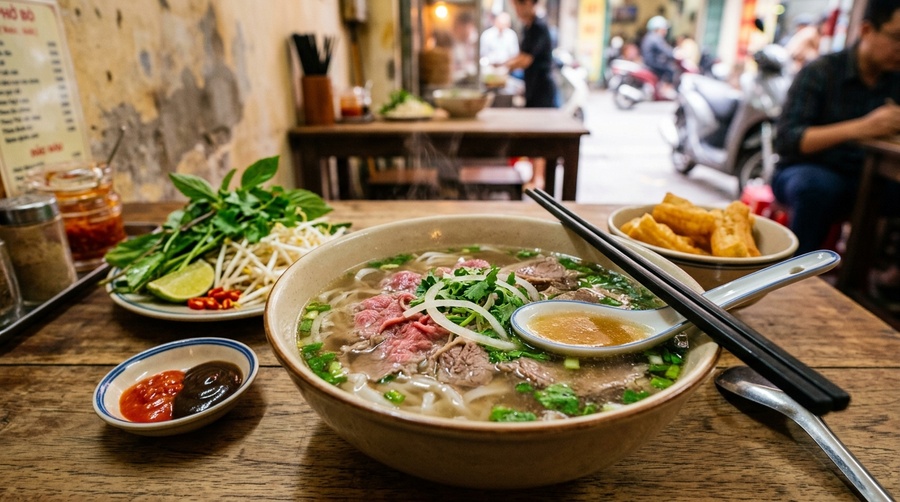
What is Phở Bò
Phở bò is a traditional Vietnamese beef soup. It is built upon three main components: a rich meat broth, flat rice noodles called bánh phở, and beef.
The word phở refers to the dish itself and the type of rice noodles used, while bò translates to "beef."
Another popular version is phở gà, made with chicken. However, beef phở bò is most commonly perceived as one of the country's main culinary symbols.
The broth, called nước dùng in Vietnamese, is prepared from beef bones and meat. It is simmered for several hours with charred onions and ginger, along with fragrant spices: star anise, cinnamon, cloves, coriander, and black cardamom.
Recipes vary from region to region and even from one family eatery to another. A properly prepared broth remains relatively clear while possessing a deep meaty flavor and a warm, spicy aroma. A good phở bò is rich, yet not heavy.
How Phở Bò Originated
It is believed that phở developed in northern Vietnam in the early 20th century. One of its main centers of origin is said to be Nam Định province, located not far from Hà Nội. Later, the dish spread throughout the country and became part of everyday cuisine.
The recipe's development was likely influenced by multiple culinary traditions. It combined local rice noodles, Vietnamese herbs and spices, and the practice of long-simmering meat broth.
Following the division of the country in the mid-20th century, northerners began moving south, bringing their familiar recipes with them. As a result, different regional variations of phở emerged.
Today, the debate over which soup is better—the restrained Hanoi style or the generous Saigon style—remains a part of Vietnam's food culture.
Northern vs. Southern Phở Bò: What’s the Difference?
While traveling through Vietnam, a tourist may notice that phở bò in Hanoi differs noticeably from the soup served in Thành phố Hồ Chí Minh (Ho Chi Minh City).
Northern Phở
The northern version is called phở Bắc—literally "northern phở." It is characterized by minimalist presentation and a more restrained flavor.
The broth is typically clear, slightly salty, and balanced, without prominent sweetness. The bowl contains noodles, meat, green onions, and a small amount of fresh herbs. Additional sauces are used sparingly so as not to overpower the flavor of the broth.
In Hanoi, the soup is often served with quẩy—long strips of fried dough resembling unsweetened crullers. They are dipped into the broth or broken right into the bowl.
Southern Phở
The southern version is called phở miền Nam, meaning "phở of the southern region." You may also encounter the name phở Sài Gòn (Saigon phở).
This soup typically has a sweeter and richer flavor. It is accompanied by a large plate of accompaniments: bean sprouts (giá đỗ), Thai basil (húng quế), other fresh herbs, lime, and chili peppers.
The table is often stocked with a sweetish Hoisin sauce, known in Vietnam as tương đen, and a spicy chili sauce called tương ớt.
The southern version allows diners to assemble the final flavor of the dish themselves. You can add more herbs to the bowl, make the broth more acidic with lime, or make it spicier with fresh chili.
Choosing the Meat
On the menus of Vietnamese eateries, phở bò can appear in several variations. The differences usually relate to the preparation method and the cut of beef used.
Phở bò tái is served with very thin slices of raw or lightly cooked beef. The meat is placed in the bowl before serving and cooks right in the hot broth. This is one of the most popular options.
Phở bò chín is made with fully cooked, boiled beef. This soup is ideal for travelers who prefer well-done meat.
Tái nạm combines thin slices of lightly cooked beef (tái) with boiled beef flank (nạm).
Phở bò viên is served with chewy beef meatballs (bò viên). They can be added on their own or combined with other types of meat.
In some establishments, the soup may also include:
- Beef tendon — gân
- Tripe — sách
- Fatty brisket — gầu
- Beef meatballs — bò viên
For travelers who are not ready for offal or unfamiliar textures, it is best to clarify the ingredients in advance. The most universal choices are tái (thin slices of meat) or chín (fully cooked beef).
In many eateries, you can order a mixed version with multiple types of meat—phở bò đặc biệt. The word đặc biệt means "special" or "extra."
How to Eat Phở Bò Correctly
There are no strict rules for the dish, but a few simple recommendations will help you better appreciate its flavor.
First, try a few spoonfuls of the plain broth without any additions. This showcases the chef's skill and defines the soup's character. After that, you can add herbs, bean sprouts, lime juice, or a little chili.
There is no need to pour a lot of sauce into the bowl right away. Hoisin (tương đen) and chili sauce (tương ớt) can completely alter the taste of the broth. Many locals mix them in a small separate dipping dish and dip pieces of meat into it.
Noodles and beef are eaten with chopsticks, while the broth is consumed with a spoon. It is completely acceptable in Vietnam to lift the bowl closer to your face or gently sip the soup. In a casual street eatery, no one expects strict restaurant etiquette from a tourist.
Fresh herbs are best added in small portions. You can tear them slightly with your hands to make the aroma more vibrant. Lime juice should be squeezed in gradually: too much acidity can overpower the subtle spicy notes.
When Do Vietnamese People Eat Phở?
Although phở bò can be found on menus all day long, it is traditionally eaten for breakfast. Early in the morning, office workers, students, drivers, and local shop owners gather at popular street spots.
Some small family-run eateries operate for just a few hours. They open at dawn and close as soon as the prepared broth runs out. Therefore, it is best to go for morning phở before 9:00 or 10:00 AM.
In major tourist cities, the soup is also served in the evening. A late-night bowl of phở is especially popular after walks, trips, or bar visits: the hot broth is satisfying without feeling overly heavy.
Where to Try Authentic Phở Bò
The best phở is not always served in a place with a nice interior and an English menu. Often, the most interesting spots look very simple: a few metal tables, plastic chairs, a large pot of broth, and a queue of locals.
When choosing a cafe, look for a few telltale signs:
- The establishment specializes in just one or two dishes.
- Locals are eating near the entrance.
- Noodles and herbs are prepared in small portions.
- The broth is actively consumed.
- Food is protected from the sun and street dust.
- Tables and tableware look clean.
In Hanoi, look for traditional phở Bắc with a minimal number of additions. Many small eateries are located in the Old Quarter and residential neighborhoods beyond the tourist center.
In Ho Chi Minh City, the richer southern phở—phở miền Nam—is prevalent. Here, a basket of herbs, bean sprouts, and several sauces are almost always served with the soup.
You should also try phở in Nam Định. The local version is called phở bò Nam Định. Family recipes may differ in how the broth is made, the blend of spices, the type of noodles, and how the meat is sliced.
How to Order Phở Bò in Vietnam
To order, it is enough to memorize or save a few names on your phone:
- phở bò — beef phở
- phở bò tái — phở with thin slices of lightly cooked beef
- phở bò chín — phở with fully cooked meat
- phở tái nạm — phở with thin beef slices and boiled flank
- phở bò viên — phở with beef meatballs
- phở bò đặc biệt — special phở with multiple types of meat
- phở gà — chicken phở
- không cay — not spicy
- ít cay — slightly spicy
- không rau — without herbs
- không hành — without onions
- không giá — without bean sprouts
The phrase "Cho tôi một tô phở bò" means "Give me one portion of phở bò." A shorter option is simply to point to the desired line on the menu and say "một tô," meaning "one bowl."
Tones are very important in Vietnamese, so a foreigner's pronunciation might not be understood immediately. In such situations, it's easier to show the dish name on your phone screen.
Chili peppers and spicy sauces are usually served separately, so classic phở bò is not necessarily spicy. Travelers with food allergies should keep in mind that the broth may contain fish sauce (nước mắm), and the ingredients of extra condiments are not always listed on the menu.
How Much Does Phở Bò Cost?
Phở bò is considered an affordable everyday dish. At a street food stall or small family cafe, its price is usually lower than in tourist-center restaurants. The price depends on the city, portion size, chosen meat, and the establishment's style.
A small portion is denoted by the word nhỏ, and a large one by lớn. Menus may also use expressions like:
- tô nhỏ — small bowl
- tô lớn — large bowl
For a light breakfast, a small portion is often enough, while a large one is worth choosing after a long walk or trip.
Before ordering at a place without a menu, it's useful to ask the price. You can ask: "Bao nhiêu tiền?" — "How much does it cost?"
Why Phở Bò Should Be Tried in Vietnam
Phở bò has long been cooked all over the world, but in Vietnam, the dish is experienced differently. Here, it is tied to the city's rhythm, morning market noise, the scent of fresh herbs, and the habit of starting the day at a small table on the sidewalk.
Moreover, a trip allows you to try multiple variations of the soup. Northern phở Bắc introduces the clean, restrained flavor of the broth; southern phở miền Nam offers an abundance of herbs and sauces; and family recipes in small towns reveal lesser-known sides of the dish.
A bowl of phở bò is one of the most accessible ways to touch Vietnamese culture. You don't need a prior reservation or a special occasion for it. It's enough to find a spot where locals fill the tables, order a hot soup, and take your time with the additions. The first sip of broth will tell you more about Vietnam than a long list of sights.