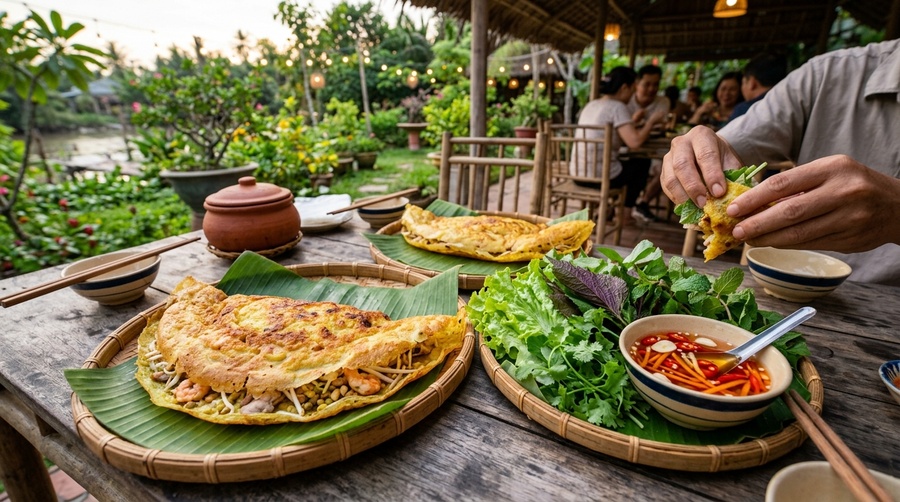
What is Bánh Xèo Miền Tây
Bánh xèo miền Tây is a large southern Vietnamese rice pancake cooked in a wide skillet.
The name consists of several parts:
- bánh — a general term for items made from dough or batter;
- xèo — the sizzling sound made when the batter hits a hot skillet;
- miền Tây — the southwestern region of Vietnam.
A single pancake can take up almost an entire large plate. It is folded in half, with a filling of meat, shrimp, bean sprouts, and green onions inside.
The dish is usually ordered to share. The finished pancake is broken into pieces, wrapped in rice paper or leaves, and dipped in sauce.
Where Bánh Xèo Miền Tây is Made
This variety is especially widespread in the Mekong Delta.
You can find it in provinces and cities such as:
- Cần Thơ;
- Bến Tre;
- Vĩnh Long;
- Tiền Giang;
- Hậu Giang;
- An Giang;
- Đồng Tháp;
- Sóc Trăng;
- Bạc Liêu;
- Cà Mau.
In each area, the composition of the filling and herbs may vary slightly. Coastal places more often use seafood, while rural areas use pork, duck, mushrooms, and local vegetables.
How Bánh Xèo Miền Tây Differs from Regular Bánh Xèo
The phrase "regular bánh xèo" is too broad, as there are many regional versions in Vietnam.
The main features of bánh xèo miền Tây:
- large size;
- thin, crispy crust;
- coconut milk in the batter;
- bright yellow color;
- pork and shrimp filling;
- a large amount of bean sprouts;
- a generous assortment of herbs;
- a mild, slightly sweet taste;
- sweet-and-sour fish sauce.
Central bánh xèo are usually smaller, denser, and saltier. They may contain less coconut milk and feature a spicier sauce.
What the Batter is Made Of
The base is rice flour, bột gạo.
The batter usually includes:
- water;
- coconut milk, nước cốt dừa;
- turmeric, nghệ;
- salt;
- green onions, hành lá;
- sometimes starch;
- sometimes carbonated water or beer.
Coconut milk is one of the main features of the Mien Tay version. It gives the batter a light sweetness and a soft aroma.
Turmeric creates a golden-yellow color. Eggs are typically not included in the classic batter, although the pancake truly resembles an omelet in appearance.
How the Crispy Crust is Achieved
A good bánh xèo miền Tây must be thin and crispy at the edges.
To achieve this:
- the skillet is heated thoroughly;
- a small amount of batter is used;
- it is quickly distributed across the entire surface;
- enough oil is added;
- the pancake is not overloaded with filling;
- it is cooked until excess moisture evaporates;
- it is served immediately after frying.
If the batter is too thick, the crust will turn out heavy. If the bean sprouts release too much water, the inner part will become soggy.
In some eateries, the edges of the pancake are additionally drizzled with hot oil to make them extra crispy.
Pork
The main meat filling is pork, thịt heo.
Most often, thin slices of pork belly, ba chỉ, or meat with a small amount of fat are used.
The pork is lightly pre-fried in a skillet. Then shrimp is added, and the ingredients are covered with batter.
Layers of fat make the filling juicier and complement the coconut aroma of the batter well.
Shrimp
Shrimp is called tôm.
In the Mekong Delta, they may use:
- small river shrimp;
- freshwater shrimp;
- large shrimp;
- whole shrimp in shells;
- peeled shrimp.
Small shrimp are often left whole. The shell enhances the aroma, but eating such a filling requires care.
In coastal areas, shrimp may be combined with squid and other seafood.
Bean Sprouts
Bean sprouts, giá đỗ, are an essential component of classic bánh xèo miền Tây.
They are placed inside near the end of cooking. The sprouts soften slightly under the lid but must retain their crunch.
They provide volume to the filling and balance the richness of the pork and fried batter.
Green Onion
Green onion, hành lá, is usually added directly into the batter.
It imparts a fresh aroma and creates green specks on the golden surface.
Sometimes chopped regular onions are also added to the filling.
Mushrooms and Other Additions
In different provinces, the filling may include:
- mushrooms, nấm;
- bamboo shoots, măng;
- coconut palm heart, củ hủ dừa;
- green beans;
- cassava;
- onions;
- local aquatic plants.
The version with coconut palm heart is especially interesting. It has a delicate, crunchy texture and is frequently used in Ben Tre cuisine.
How Bánh Xèo Miền Tây is Cooked
First, oil is heated in a large skillet. Then the pork and shrimp are quickly stir-fried.
After that, liquid batter is poured in with a ladle, and the skillet is swirled so the batter spreads in a thin layer.
Next, bean sprouts are added, the skillet is covered with a lid, and the filling is allowed to steam slightly.
When the edges turn golden and easily pull away from the surface, the lid is removed. The pancake is folded in half and transferred to a plate.
It must be cooked immediately before serving. Just a few minutes later, the steam from the filling begins to soften the crust.
What is Served with Bánh Xèo Miền Tây
Fresh Herbs
A large plate of herbs, rau sống, is brought with the dish.
It may include:
- leaf lettuce, xà lách;
- mustard greens, cải bẹ xanh;
- mint;
- cilantro;
- perilla, tía tô;
- Vietnamese balm, kinh giới;
- basil;
- cucumber;
- young mango leaves;
- local tree leaves;
- green banana;
- star fruit, khế.
In the Mekong Delta, the selection of herbs can be especially diverse. Sometimes more than ten types of leaves and grasses are placed on the table.
Rice Paper
The pancake is often wrapped in rice paper, bánh tráng.
The sheet is lightly moistened with water, then herbs and a piece of bánh xèo are placed on it.
The roll is wrapped fairly tightly, but not too snug, so the crispy crust doesn't tear the paper.
In some eateries, rice paper is not served. In that case, pieces are wrapped directly in lettuce or mustard leaves.
Sweet-and-Sour Fish Sauce
The main dipping sauce is nước chấm.
It is prepared from:
- fish sauce, nước mắm;
- water;
- sugar;
- lime juice or vinegar;
- garlic;
- chili;
- pickled carrot;
- daikon or green papaya.
In the Mekong Delta, the sauce is often made noticeably sweet. This is a characteristic feature of southern cuisine.
The roll is dipped in the sauce immediately before eating. Do not keep it in the liquid for too long, or the rice paper and crust will get soggy.
Peanut Sauce
In some establishments, a thick peanut sauce, tương đậu phộng, may be served.
It is less common than the classic fish sauce and usually belongs to chef-inspired or adapted presentations.
The sauce has a sweet, salty, and nutty flavor.
Varieties of Bánh Xèo Miền Tây
There is no single strict classification. Varieties differ primarily in their filling and local ingredients.
Classic Bánh Xèo Tôm Thịt
Bánh xèo tôm thịt is the classic version with shrimp and pork.
The words mean:
- tôm — shrimp;
- thịt — meat.
This is the most widespread version in the Mekong Delta. It best showcases the character of southern bánh xèo: sweetish batter, juicy filling, and an abundance of herbs.
Bánh Xèo with Shrimp
Bánh xèo tôm is prepared with shrimp only.
Pork is not added, but fish sauce usually remains part of the presentation.
The taste turns out lighter and distinctly marine.
Bánh Xèo with Pork
Bánh xèo thịt heo is a version with pork only.
It suits those who do not eat shrimp, though it is important to check the composition of the sauce.
Bánh Xèo with Duck
Bánh xèo vịt is prepared with duck meat.
The word vịt means "duck."
The meat is pre-marinated and stir-fried. This version features a richer and oilier taste.
It is found in certain areas of the Mekong Delta, though less commonly than the classic shrimp and pork version.
Bánh Xèo with Seafood
Bánh xèo hải sản is a seafood version.
The filling may include:
- shrimp;
- squid;
- octopus;
- clams;
- fish.
Such a variety is especially characteristic of the southern coastal provinces.
Bánh Xèo with Squid
Bánh xèo mực is prepared with squid.
The squid is quickly stir-fried before the batter is added. If cooked for too long, it becomes tough.
Bánh Xèo with Coconut Palm Heart
Bánh xèo củ hủ dừa is a distinctive southern variety featuring coconut palm heart.
Củ hủ dừa is the tender inner core of a young coconut palm trunk.
It has a light color, a mild vegetable flavor, and a pleasant crunch. This version is especially appropriate to try in Ben Tre province, famous for its coconut plantations.
The palm heart can be combined with shrimp, pork, or used in a vegetarian version.
Bánh Xèo with Mushrooms
Bánh xèo nấm is prepared with mushrooms.
The filling may include:
- oyster mushrooms;
- shiitake;
- straw mushrooms;
- wood ear mushrooms.
The version can be either meaty or vegetarian.
Bánh Xèo with Điên Điển Flowers
During the Mekong flood season, you can find bánh xèo with yellow bông điên điển flowers.
This is a popular product of southwestern Vietnam. The flowers possess a fresh, slightly bitter taste and retain a light crunch.
They may be added to the filling along with shrimp or fish.
This option is particularly associated with the seasonal cuisine of the delta.
Bánh Xèo with Wild Ducks and Local Herbs
In rural areas, author and homemade versions with local duck, small fish, snails, and wild-growing herbs can be found.
Such variants do not have a single unified name. On the menu, the main ingredient is usually added after the words bánh xèo.
Vegetarian Bánh Xèo Miền Tây
Bánh xèo miền Tây chay is the vegetarian version.
The filling may include:
- tofu;
- mushrooms;
- coconut palm heart;
- bean sprouts;
- carrots;
- green beans;
- vegetables.
The sauce must be prepared without fish sauce, usually on a soy base.
Strict vegans should check whether eggs are added to the batter and whether regular fish sauce is used.
Bánh Xèo Đặc Biệt
Bánh xèo đặc biệt is a special version.
The word đặc biệt means "special."
It may contain:
- more shrimp;
- more meat;
- squid;
- additional vegetables;
- egg;
- an especially large size.
The composition depends on the specific establishment.
How Bánh Xèo Miền Tây Differs from Bánh Xèo Miền Trung
Bánh xèo miền Trung is the central version of the dish.
Main differences:
Bánh xèo miền Tây:
- large;
- thin;
- bright yellow;
- often contains coconut milk;
- has a sweetish taste;
- served with an abundance of herbs;
- usually filled with pork and shrimp.
Bánh xèo miền Trung:
- small;
- denser;
- often less yellow;
- usually without a pronounced coconut flavor;
- saltier and spicier;
- may be served with a thick sauce;
- often ordered in multiples.
One southern bánh xèo may be sized for two people, whereas a single person will need several central pancakes.
How Bánh Xèo Miền Tây Differs from Bánh Khọt
Bánh khọt are small, round rice pancakes with shrimp.
Differences:
- bánh xèo is fried in a large flat skillet;
- bánh khọt are cooked in a mold with round indentations;
- bánh xèo is folded in half;
- bánh khọt remain open;
- there are plenty of bean sprouts inside bánh xèo;
- each bánh khọt usually has a single shrimp on top;
- bánh xèo is significantly larger.
Both dishes are eaten with rice paper, herbs, and fish sauce.
How to Eat Bánh Xèo Miền Tây Correctly
First, the pancake is broken into small pieces using chopsticks, a spoon, or hands.
Then the rice paper is prepared:
- lightly moisten the sheet with water;
- place a few herb leaves on it;
- add cucumber and greens;
- place a piece of bánh xèo with filling;
- fold in the edges;
- roll into a tight cylinder;
- dip in the sauce.
Do not put too large a piece. A thick roll is hard to wrap, and the crispy crust can tear the rice paper.
Some of the herbs can be used instead of paper—for instance, wrapping the filling in a large mustard or lettuce leaf.
Should Rice Paper Be Moistened?
This depends on its type.
Thin, soft paper can sometimes be passed through water just once. A denser sheet is moistened on both sides.
Do not wait until the paper becomes fully soggy. It will continue softening right on the plate.
If you wet it too much, the sheet will start tearing and sticking to your hands.
How to Order Bánh Xèo Miền Tây
You may encounter the following names on the menu:
- bánh xèo miền Tây — bánh xèo miền Tây;
- bánh xèo tôm thịt — with shrimp and pork;
- bánh xèo tôm — with shrimp;
- bánh xèo thịt heo — with pork;
- bánh xèo vịt — with duck;
- bánh xèo hải sản — with seafood;
- bánh xèo mực — with squid;
- bánh xèo củ hủ dừa — with coconut palm heart;
- bánh xèo nấm — with mushrooms;
- bánh xèo chay — vegetarian version;
- bánh xèo đặc biệt — special version;
- không tôm — without shrimp;
- không thịt — without meat;
- không giá — without bean sprouts;
- không cay — not spicy;
- thêm rau — add herbs;
- thêm bánh tráng — add rice paper;
- thêm nước chấm — add sauce.
The phrase một cái bánh xèo miền Tây means "one bánh xèo miền Tây."
For a full portion to share, you can simply specify the required number of pancakes.
When is the Best Time to Eat Bánh Xèo Miền Tây
The dish is most often ordered for lunch or dinner.
It is especially well-suited for a communal meal, as one large pancake is convenient to share among several people.
It is best to arrive during peak hours when the batter and filling are prepared continuously. Bánh xèo should reach the table straight from the skillet.
During the rainy season, hot crispy pancakes are especially popular, but they are eaten year-round in the Mekong Delta.
Where is the Best Place to Try Bánh Xèo Miền Tây
The best place to get acquainted with the dish is the provinces of the Mekong Delta.
Of particular interest are:
- Cần Thơ;
- Bến Tre;
- Vĩnh Long;
- Mỹ Tho;
- Cà Mau;
- Sóc Trăng;
- An Giang.
In a good establishment:
- pancakes are fried to order;
- the edges are thin and crispy;
- the coconut aroma is noticeable but not overwhelming;
- the shrimp and meat are not overdried;
- the bean sprouts retain their crunch;
- the herbs look fresh;
- rice paper is brought separately;
- the sauce is not too salty;
- there are many locals among the patrons.
If a pancake has been sitting ready for too long, its edges become soft and the bottom becomes oily.
What a Tourist Should Consider
Classic bánh xèo miền Tây may contain:
- pork;
- shrimp;
- fish sauce;
- coconut milk;
- bean sprouts;
- raw herbs;
- sometimes eggs.
If you have a crustacean allergy, you should order the version without shrimp and clarify the composition of the sauce.
If you have a fish allergy, keep in mind that nước chấm is prepared with fish sauce.
Coconut milk is not in every recipe, but it is very characteristic of the Mien Tay version.
Shrimp may be left in their shells.
The pancake itself is usually not spicy, but fresh chili may be present in the sauce.
Fresh herbs often do not undergo thermal processing, so it is worth choosing popular and clean establishments.
Why You Should Try Bánh Xèo Miền Tây
Bánh xèo miền Tây well conveys the character of Mekong Delta cuisine: generous, sweetish, aromatic, and rich in fresh herbs.
A single dish combines crispy rice batter, coconut aroma, juicy pork, sweet shrimp, fresh sprouts, and an array of herbs.
The main impression is created not just by the pancake itself, but by the way it is eaten. Each diner independently assembles their roll, chooses the herbs, and adjusts the amount of sauce.
For a first introduction, it is best to order the classic bánh xèo tôm thịt with shrimp and pork. In Ben Tre province, you should also try the version with coconut palm heart — bánh xèo củ hủ dừa.