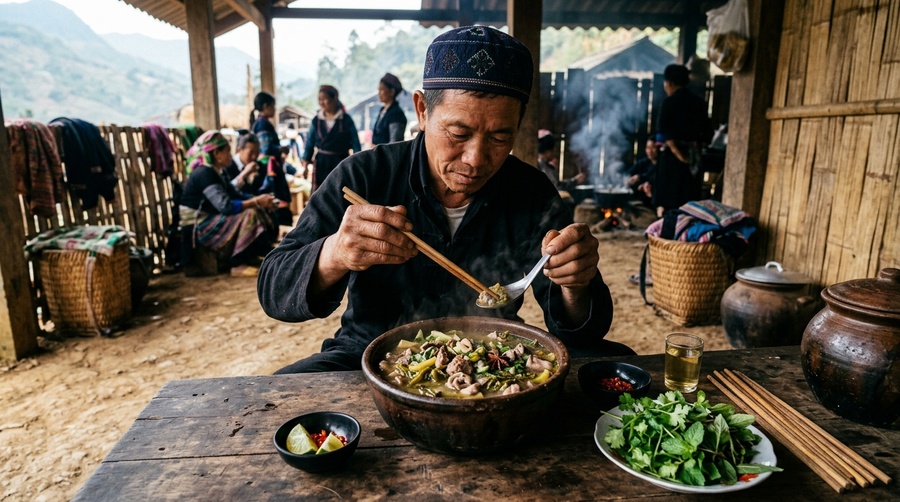
Thang co (thắng cố) is a rich, hearty meat dish from the northern mountainous regions of Vietnam. It is distinguished by its long cooking time, flavorful broth, and the use of a wide variety of spices.
In the classic version, meat, bones, and offal are placed in a cauldron. The ingredients may first be stir-fried to render some of the fat and enhance the aroma, after which water is added and everything is simmered for a long time over low heat.
The result is a thick, rich, and deeply flavorful broth. The meat becomes tender, and the spices give the dish its characteristic warm aroma.
Thang co is often prepared not for a single person, but for a large group. It can be found at mountain markets, festivals, family celebrations, and communal gatherings.
How to Pronounce the Name
The Vietnamese name of the dish is written as thắng cố.
In Russian, it is best transliterated as тханг ко (thang co). Variations like "thangko" and "thang kou" also exist, but they reflect the original pronunciation less accurately.
The word thắng cố is rooted in the Hmong language and culinary tradition. There is no single literal translation into Russian, so the name is usually left untranslated.
Where Thang Co is Prepared
The dish is primarily widespread in the northern mountainous provinces of Vietnam:
- Ha Giang (Hà Giang);
- Lao Cai (Lào Cai);
- Lai Chau (Lai Châu);
- Dien Bien (Điện Biên);
- Son La (Sơn La);
- Yen Bai (Yen Bái).
Thang co is especially common at high-altitude markets. A large cauldron is placed over a fire, and the dish cooks for several hours.
Visitors sit nearby at simple tables and receive a portion of hot meat with broth. Sometimes a cauldron or small pot is set directly on the table so the dish stays warm throughout the meal.
What Meat is Used to Make Thang Co
Originally, thang co was most often made from horsemeat. Today, the composition depends on the region, the establishment, and customer preferences.
Horsemeat
The traditional version is called thang co nguva (thắng cố ngựa).
The word nguva (ngựa) means "horse" or "horsemeat."
The dish may include:
- meat;
- bones;
- fat;
- liver;
- heart;
- stomach;
- intestines;
- other offal.
Modern restaurants frequently use only meat and more familiar cuts of the carcass. At traditional markets, the ingredients can be much more diverse.
Beef
Thang co bo (thắng cố bò) is the beef variation.
The word bo (bò) means "cow" or "beef."
Beef thang co usually has a flavor more familiar to tourists. The broth is rich, but the smell may be less pungent than that of the traditional horsemeat and offal dish.
Buffalo Meat
Thang co chau (thắng cố trâu) is made from buffalo meat.
The word chau (trâu) means "water buffalo."
Buffalo meat is denser than beef and requires prolonged cooking. After long simmering, the meat becomes tender, and the broth acquires a deep, meaty flavor.
Goat Meat
Thang co ze (thắng cố dê) is the goat meat variation.
The word ze (dê) means "goat" or "goat meat."
Goat meat has a pronounced aroma, so it is usually cooked with plenty of spices, ginger, and aromatic herbs.
Pork
Thang co kheo (thắng cố heo) or thang co lon (thắng cố lợn) is made from pork.
The words kheo (heo) and lon (lợn) mean "pig." The former is more commonly used in the south, while the latter is used in northern Vietnam.
The pork version is typically rich and tender. It can be prepared using meat, bones, and offal.
Which Parts of the Carcass Are Used
One of the main features of traditional thang co is the use of almost all edible parts of the animal.
The cauldron may contain:
- pulp meat;
- ribs;
- bones;
- fat;
- skin;
- liver;
- heart;
- lungs;
- stomach;
- intestines.
This approach stems from the traditional lifestyle of mountain communities, where slaughtering an animal was a major event and people tried to use every part of it.
In modern tourist restaurants, the recipe is often adapted. The dish is prepared primarily from meat and bones, and the amount of offal is reduced.
If a traveler does not want to try internal organs, it is best to clarify the ingredients before ordering.
Useful phrase:
Không nội tạng — without offal.
The word noi tang (nội tạng) means "internal organs" or "offal."
What Spices Are Added
The exact blend of spices varies by family and establishment. Traditional thang co may include both familiar seasonings and local mountain plants.
Most commonly used:
- ginger gung (gừng);
- lemongrass sa (sả);
- star anise hoi (hồi);
- cinnamon que (quế);
- cardamom thao kuam (thảo quả);
- pepper;
- garlic toi (tỏi);
- shallots hanh tim (hành tím);
- salt;
- fish sauce nuok mam (nước mắm);
- local aromatic herbs.
A particularly characteristic ingredient for northern mountain cuisine is black cardamom thao kuam (thảo quả). Its large pods possess a smoky, spicy, and slightly camphor-like aroma.
Some recipes also use seeds and leaves of local plants whose composition can be difficult to replicate outside of the specific region.
How Thang Co is Prepared
Preparation begins with cleaning the meat and offal. They are thoroughly washed, cleaned, and cut into large pieces.
The subsequent process may include several stages:
- the meat and offal are cut;
- spices are crushed or stir-fried;
- ingredients are mixed with seasonings;
- the meat is lightly seared in its own fat;
- water is added;
- the dish is brought to a boil;
- scum is skimmed off;
- simmered for a long time over low heat.
Thang co can cook for several hours. During this time, the tough meat and offal soften, and the broth becomes thick and rich.
At markets, large metal cauldrons are used. The dish may remain on low heat throughout the entire day, with new portions added as they cook.
What Thang Co Looks and Smells Like
The appearance of the dish depends on its ingredients. It is usually a dark or brownish broth with large pieces of meat, fat, and offal.
A noticeable layer of fat may sit on the surface. For traditional thang co, this is normal: the dish was created as a nourishing hot meal for a cool mountain climate.
The aroma is strong and spicy. Notes that may be detected include:
- meat broth;
- smoke;
- cardamom;
- cinnamon;
- anise;
- ginger;
- offal.
The tourist version usually has a milder scent. The traditional market version may seem unusual even to those well-acquainted with Asian cuisine.
Varieties of Thang Co
There is no single official classification of the dish. Varieties primarily differ by the meat used, the composition of the offal, and the serving method.
Traditional Horsemeat Thang Co
Thang co nguva (thắng cố ngựa) is considered the most traditional option.
It is made from horsemeat, bones, and various internal organs. The dish is simmered for a long time with spices in a large cauldron.
The flavor of this thang co is rich, fatty, and quite robust. The offal gives the broth added depth while creating a distinct aroma.
This version is more frequently found at traditional markets and festivals of northern ethnic groups.
Beef Thang Co
Thang co bo (thắng cố bò) is one of the most accessible varieties.
Beef is more familiar to most tourists, so this option is frequently offered by traveler-oriented restaurants.
The dish may include beef ribs, brisket, bones, tripe, and other cuts. Adapted versions use only meat.
Buffalo Thang Co
Thang co chau (thắng cố trâu) stands out for its dense meat and deep broth flavor.
Buffalo meat is quite lean and can be tough, so it is cooked for a long time. Fat or softer cuts of meat are sometimes added to the cauldron to make the dish juicier.
This version is especially characteristic of regions where water buffalo are traditionally used in agriculture.
Goat Thang Co
Thang co ze (thắng cố dê) is prepared using goat meat, bones, and sometimes offal.
Goat meat has a bright aroma, which is paired with ginger, lemongrass, cardamom, and other spices.
The dish may turn out less fatty than the pork or horsemeat versions, but its flavor remains rich.
Pork Thang Co
Thang co lon (thắng cố lợn) is widespread in places where horsemeat is rare or expensive.
Pork makes the broth rich and tender. Ribs, skin-on meat, stomach, and intestines may be used for preparation.
Pork thang co sometimes resembles a thick meat stew, though the spice blend retains the character of northern mountain cuisine.
Mixed Thang Co
Some establishments prepare thang co using multiple types of meat at once. Such a version may include beef, buffalo, pork, or goat.
A mixed composition helps yield a richer broth, though the name of the dish does not always indicate all ingredients.
Before ordering, it is worth asking:
Thắng cố này là thịt gì? — What meat is this thang co made from?
The phrase thit zi (thịt gì) means "what meat."
Thang Co Without Offal
In tourist restaurants, an adapted version prepared exclusively from meat and bones can be found.
It retains the basic spices and the long simmering method, but features a milder aroma and a uniform texture.
This option may not have a separate name. Before ordering, you should check whether internal organs are included in the dish.
Phrase:
Chỉ thịt, không nội tạng — only meat, without offal.
Thang Co Hot Pot
Some establishments serve the dish as a hot pot lau thang co (lẩu thắng cố).
The word lau (lẩu) means "hot pot."
A pot with broth and cooked meat is placed on the table. Diners can additionally add:
- greens;
- mushrooms;
- vegetables;
- tofu;
- noodles;
- meat;
- offal.
This version is convenient for groups and stays hot longer. However, it can differ noticeably from traditional market thang co.
What Thang Co is Served With
The dish is eaten hot. Small bowls, chopsticks, and soup spoons may be provided.
Accompaniments include:
- fresh greens;
- mountain herbs;
- green onions;
- chili pepper;
- salt;
- ground pepper;
- pickled garlic;
- noodles;
- rice;
- corn flatbreads.
At traditional markets, thang co is often eaten without elaborate side dishes, paired only with spicy sauce and a local beverage.
Sauce for Thang Co
A sauce made from salt, chili, and local spices may be served with the meat.
Particularly famous is the seasoning made from makkhan mak khen (mắc khén) — aromatic seeds used in the cuisine of northwestern Vietnam.
In flavor, makkhan resembles a combination of citrus zest, pepper, and a light spiciness. It may cause a slight tingling or numbing sensation on the tongue.
The sauce may include:
- salt;
- fresh or dried chili;
- makkhan;
- lime juice;
- garlic;
- minced herbs.
Pieces of meat are removed from the broth and dipped into the seasoning.
Thang Co and Corn Wine
The dish is frequently associated with corn alcohol zyou ngo (rượu ngô).
The word zyou (rượu) means an alcoholic beverage, and ngo (ngô) means "corn."
Corn alcohol is especially common in the northern mountain regions. It may be served in small portions during a communal meal.
This combination is considered part of the local drinking culture, but travelers should keep the beverage's strength in mind. Homemade alcohol can be significantly stronger than it appears, and the exact alcohol content is usually not indicated.
How to Properly Eat Thang Co
Thang co is served very hot, so it is best to let the broth cool down a bit first.
Meat and offal are picked up with chopsticks, while the liquid is eaten with a spoon. If a communal pot is on the table, each person transfers a small portion into their own bowl.
Convenient order:
- pour a little broth into the bowl;
- add a few pieces of meat;
- taste the dish without condiments;
- add chili if desired;
- dip the meat in salt with makkhan;
- gradually take new pieces from the communal cauldron.
Do not add a lot of hot sauce right away. The spices in the broth itself may already be quite robust.
If unfamiliar offal is present in the portion, you can examine it carefully or ask the staff what part of the carcass it is.
How to Order Thang Co
The following names may appear on the menu:
- thắng cố — thang co;
- thắng cố ngựa — horsemeat thang co;
- thắng cố bò — beef thang co;
- thắng cố trâu — buffalo thang co;
- thắng cố dê — goat thang co;
- thắng cố lợn — pork thang co;
- lẩu thắng cố — thang co hot pot;
- nội tạng — offal;
- không nội tạng — without offal;
- chỉ thịt — meat only;
- ít mỡ — less fat;
- không cay — not spicy;
- ít cay — mildly spicy;
- một bát — one bowl;
- một nồi — one cauldron or pot.
To order a single bowl, you can say:
Một bát thắng cố — one bowl of thang co.
For a group:
Một nồi lẩu thắng cố — one pot of thang co.
How Thang Co Differs from Regular Meat Soup
The main difference lies in the ingredients and preparation method.
Regular meat soup is more often made from pulp meat and bones. Traditional thang co can include virtually all parts of the animal, including internal organs.
Additionally, the dish is distinguished by:
- a large quantity of spices;
- prolonged simmering;
- a rich, fatty broth;
- large pieces of meat;
- preparation in a communal cauldron;
- association with markets and collective feasts.
Therefore, it is more accurate to call thang co a thick meat dish or a broth-based stew rather than a standard soup.
How Thang Co Differs from Lau
Lau (lẩu) is the general term for Vietnamese hot pot. It is served in a pot over a burner, and diners cook raw ingredients in the broth themselves.
In traditional thang co, the meat has already been boiled for a long time before serving. The guest receives a finished dish and is not required to cook the ingredients themselves.
The distinction looks like this:
- thắng cố — meat and offal are pre-boiled with spices for a long time;
- lẩu — ingredients are gradually cooked in the broth right at the table;
- lẩu thắng cố — a modern presentation combining features of both dishes.
When is the Best Time to Try Thang Co
Thang co is especially well-suited for cool weather. In the mountainous regions of northern Vietnam, winter and early morning temperatures can be significantly lower than on the coast.
The hot, fatty broth warms you up and keeps you full for a long time. This is precisely why the dish is traditionally prepared at markets where residents of surrounding villages arrive early in the morning.
The best time to experience thang co is the first half of the day at a large mountain market. At this time, the dish is consumed actively, and the meat does not sit in the cauldron for too long.
How to Choose a Place
You can try thang co at a market or in a specialized restaurant.
The market version is usually more traditional, but it may contain a lot of offal and possess a strong aroma.
The restaurant version is frequently adapted for tourists. It uses more meat, fewer internal organs, and a milder spice blend.
When choosing a place, look for the following signs:
- the dish is actively ordered by locals;
- the cauldron is kept on a continuous low heat;
- the meat has no unpleasant sour odor;
- the tableware looks clean;
- raw and cooked products are stored separately;
- the staff can explain the ingredients;
- the broth is served hot.
If the dish looks barely warm or sits unheated for a long time, it is better to choose another establishment.
What a Tourist Should Keep in Mind
Traditional thang co may contain horsemeat and virtually any offal. The composition should be clarified in advance.
The dish is often very fatty. People who tolerate fatty food poorly are better off starting with a small portion and choosing primarily meat pieces.
The cauldron may contain bones, cartilage, and tough parts. Eat carefully.
At markets, thang co is prepared in large volumes. It is important to choose popular places with a high product turnover and a constantly hot cauldron.
The dish is not always spicy, but the sauces may contain a large amount of chili and local spices.
The corn alcohol served alongside it can be potent. Do not combine it with driving a motorcycle or car.
Why You Should Try Thang Co
Thang co is not just an unusual meat dish, but a part of the culture of northern mountainous Vietnam.
It is connected to traditional markets, communal feasts, and the lifestyle of local peoples. A large cauldron of thang co becomes a focal point around which people gather, talk, warm up, and share food.
For a first introduction, it is best to choose the restaurant-style thang co bo (thắng cố bò) (beef) or an adapted version without offal. After that, you can try traditional thang co nguva (thắng cố ngựa) at one of the northern markets.
It is important for a traveler to understand the composition of the dish beforehand. Thang co may seem unusual in aroma, fat content, and texture, but it is precisely these characteristics that make it one of the most distinctive dishes of mountainous Vietnam.