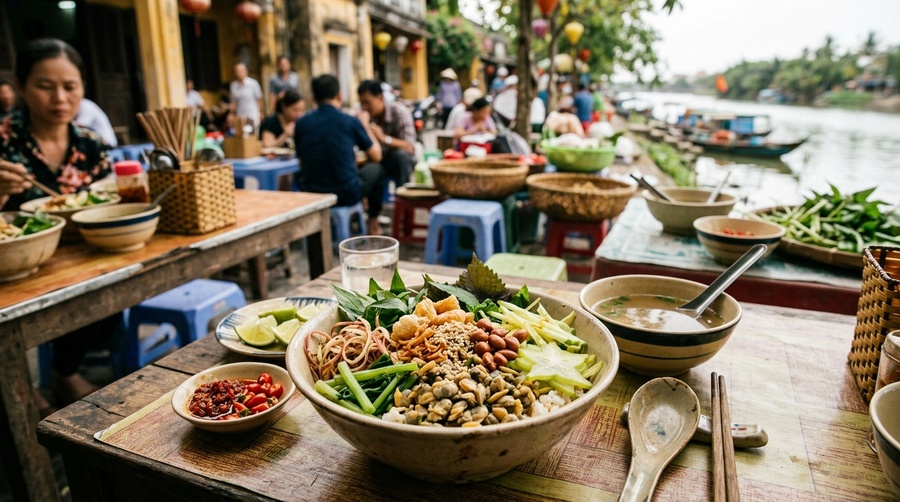
What is Cơm Hến
Cơm hến is a dish of cooked rice with tiny clams, characteristic of central Vietnam and above all the city of Huế.
Unlike regular seafood rice, the ingredients here are not stewed together. They are prepared separately and then assembled immediately before serving.
A classic portion may include:
- cooked rice;
- stir-fried clams;
- fresh herbs;
- bean sprouts;
- banana blossom;
- star fruit;
- roasted peanuts;
- crunchy pork skin;
- sesame seeds;
- spicy sauce;
- fermented shrimp paste;
- hot clam broth.
Before eating, the contents of the bowl are thoroughly mixed. As a result, the rice absorbs the sauces and aromas, and the fresh and crunchy ingredients are evenly distributed throughout the portion.
Where the Dish Originated
Cơm hến is closely tied to the Cồn Hến area—a small island on the Perfume River (sông Hương) in Huế.
The name Cồn Hến can be translated as "clam island." Local residents traditionally gathered tiny clams from the river water, boiled them, and used them to make inexpensive everyday dishes.
Originally, cơm hến was considered simple food for fishermen and poor families. A small amount of clams was mixed with leftover rice, greens, and available seasonings. Gradually, the composition of the dish became more complex, and cơm hến turned into one of the symbols of Huế cuisine.
Today it is served both in simple street eateries and in local cuisine restaurants.
What are Hến Clams
The word hến refers to very small freshwater or brackish water bivalve clams.
In size, they are significantly smaller than familiar mussels. After being removed from the shell, the meat of each clam may be only a few millimeters in size.
Hến have a tender texture and a pronounced salty-sweet flavor. A large number of clams is required for a single portion, so cleaning them takes a lot of time.
The clams are thoroughly washed to remove sand and silt, then boiled. After the shells open, the meat is separated, and the remaining liquid is saved for the broth.
How Clams Are Prepared
Fresh clams may contain sand, so they are first washed thoroughly and kept in clean water.
Then the hến are boiled until their shells open. The meat is separated manually or using water, in which lighter parts rise to the surface.
The cleaned clams are quickly stir-fried with:
- shallots (hành tím);
- garlic (tỏi);
- fish sauce (nước mắm);
- pepper;
- chili;
- sometimes lemongrass (sả).
Hến must not be cooked for too long: the small meat quickly becomes dry and tough.
What Rice is Used
Ordinary cooked white rice (cơm trắng) is suitable for the dish.
Traditionally, cơm hến was often made from rice left over from a previous meal. It was served cool or at room temperature, and hot broth was added separately.
This exact contrast between cool rice and warm clams is considered one of the features of the dish.
Modern cafes may use freshly cooked rice. It should not be too soft and sticky, otherwise after mixing with sauces it will form a heavy, homogeneous mass.
Good rice retains individual grains and absorbs seasonings without turning into porridge.
Clam Broth
The liquid left over after boiling hến is called nước hến—clam broth.
It is strained to remove sand and shell fragments, and then seasoned with salt, fish sauce, ginger, or other spices.
The broth may be served:
- in a separate small bowl;
- right next to the rice;
- in a communal container on the table;
- in a small amount on top of the finished dish.
Nước hến has a light marine flavor and helps soften the heat of the seasonings. Some diners add it to the rice little by little, while others drink it separately as a soup.
Fermented Shrimp Paste
One of the characteristic seasonings of cơm hến is fermented shrimp paste (mắm ruốc).
It is especially frequently used in Huế cuisine. Mắm ruốc has a strong aroma, high salinity, and a rich umami flavor.
Before adding, the paste may be mixed with:
- water;
- sugar;
- garlic;
- chili;
- lime juice;
- fried oil.
In cơm hến, mắm ruốc is used in small quantities. It should enhance the flavor of the clams, but not completely overpower it.
Travelers unaccustomed to fermented products are better off trying the dish with a minimal amount of paste first.
Spicy Sauce
Huế cuisine is known for its love of hot chili peppers, so traditional cơm hến can be quite fiery.
Fresh chili (ớt) or ớt chưng paste—chili fried in oil with spices—is added to the bowl.
Hot oil (sa tế) with chili, garlic, and lemongrass may also be used.
Spiciness is considered an important part of the dish, but in tourist establishments it is often adjusted. For a less spicy portion, you can say:
Ít cay — a little spicy.
For a version without extra chili:
Không cay — not spicy.
It should be noted that some amount of pepper may already be present in the clams and sauce.
Fresh Vegetables and Herbs
Cơm hến contains a particularly large amount of plant ingredients. They balance the saltiness and spiciness of the dish and also create its characteristic crunchy texture.
The portion may include:
- banana blossom (bắp chuối);
- bean sprouts (giá đỗ);
- star fruit (khế);
- mint;
- cilantro;
- Vietnamese balm (kinh giới);
- perilla (tía tô);
- scallions (hành lá);
- lettuce;
- cucumber.
The banana blossom is sliced into very thin strips and soaked in water so it does not darken and loses excess bitterness.
Star fruit adds a light acidity. In some establishments, green mango or pickled vegetables are used instead.
Roasted Peanuts
The dish is sprinkled with roasted peanuts (đậu phộng rang).
In northern Vietnam, peanuts are also called lạc, but in the central regions the word đậu phộng is more common.
The nuts can be left whole or slightly crushed. They add a sweetish aroma, fatness, and crunch.
In case of allergy, you must say in advance:
Không đậu phộng — without peanuts.
It is important to clarify the request before the portion is assembled, since small pieces of nuts are difficult to remove from an already finished dish.
Crunchy Pork Skin
Traditional cơm hến often contains crunchy pork skin (da heo chiên giòn).
The words mean:
- da heo — pork skin;
- chiên giòn — fried until crunchy.
The skin is cleaned, boiled or dried, and then fried. It becomes light, porous, and crispy.
In various establishments, it may be replaced by:
- cracklings;
- crunchy pieces of pork fat;
- fried skin slices;
- pork tendons.
This component is not always noticeable on the menu, so if avoiding pork, the composition must be clarified separately.
Sesame and Other Crunchy Toppings
Fried sesame seeds (mè rang) may be added to the dish.
Also found are:
- fried shallots (hành phi);
- rice crackers (bánh tráng nướng);
- crispy noodles;
- roasted seeds;
- pork cracklings (tóp mỡ).
The number of toppings depends on the establishment. In a good portion, they complement the clams and rice rather than drown them out.
Varieties of Hến Dishes
Hến clams in Huế are served not only with rice. Dishes with rice vermicelli, wheat noodles, and rice porridge are prepared on the same basis.
Cơm Hến
Cơm hến is the classic version with cooked rice.
Rice, clams, vegetables, herbs, peanuts, and crunchy toppings are placed in the bowl. The broth is served separately or added in a small amount.
This version is considered the most traditional and best shows the contrast of textures.
Bún Hến
Bún hến is the variant with thin rice vermicelli.
The word bún means rice noodles or vermicelli.
Soft white noodles are used instead of rice. The remaining components usually remain similar:
- clams;
- banana blossom;
- bean sprouts;
- herbs;
- peanuts;
- chili;
- mắm ruốc;
- broth.
Bún hến is perceived as a lighter and wetter dish. The noodles absorb the sauce faster, so the portion is best eaten immediately after mixing.
Mì Hến
Mì hến is prepared with wheat or egg noodles.
The word mì means noodles, usually wheat.
This version has a denser texture. Yellow noodles go well with salty clams and spicy sauce.
Mì hến is less common than cơm hến and bún hến, but it can be found in specialized establishments in Huế.
Cháo Hến
Cháo hến is rice porridge with clams.
The word cháo means liquid rice porridge.
Rice is boiled in broth for a long time until soft, then clams, scallions, pepper, and other seasonings are added.
Cháo hến has a milder flavor and does not contain as many raw vegetables and crunchy toppings as classic cơm hến.
This version is often chosen for breakfast or in cool weather.
Hến Xúc Bánh Tráng
Hến xúc bánh tráng is stir-fried clams eaten with rice crackers.
The word xúc in this context means "to scoop up."
The clams are stir-fried with onions, chili, lemongrass, and spices. The rice cracker is broken into pieces and used to scoop up the filling.
This is a separate appetizer, not a variety of cơm hến, but it is prepared from the same clams.
Cơm Hến Đầy Đủ
Cơm hến đầy đủ is a full portion with all the toppings.
The words đầy đủ mean "complete set."
It may include:
- an increased portion of clams;
- pork skin;
- cracklings;
- peanuts;
- sesame seeds;
- banana blossom;
- bean sprouts;
- herbs;
- spicy sauce;
- a separate bowl of broth.
The composition depends on the specific establishment.
Cơm Hến Đặc Biệt
Cơm hến đặc biệt is a special or upgraded version.
The word đặc biệt means "special."
It may differ by a larger amount of clams, additional crunchy ingredients, or an increased portion size.
There is no universal distinction between the đầy đủ and đặc biệt options—each cafe determines their composition independently.
Cơm Hến Without Pork
The dish may not contain noticeable pieces of meat, but pork skin or cracklings are often present.
To order a portion without pork, you can say:
Không da heo, không tóp mỡ — without pork skin and cracklings.
At the same time, clams, fish sauce, and shrimp paste will still remain in the composition.
Less Spicy Cơm Hến
An adapted version with a small amount of chili is not called a separate dish, but is indicated by the request ít cay.
You should also ask not to add hot oil:
Không thêm ớt — do not add chili.
Completely removing the spiciness can be difficult, as pepper is sometimes already included in the stir-fried clams or ready-made dressing.
Vegetarian Imitation
In some vegetarian restaurants you can find cơm hến chay.
The word chay means "vegetarian" or "vegan/Lenten."
Real clams are replaced by:
- mushrooms;
- tofu;
- chopped vegetables;
- plant protein products.
Fermented shrimp paste is replaced by soy sauce or a plant-based fermented seasoning.
This is a modern adaptation. It reproduces the presentation method and texture combination, but noticeably differs from the original dish.
How to Eat Cơm Hến Properly
Before eating, the contents of the bowl must be thoroughly mixed.
Sauces and clams may be at the bottom, while herbs, peanuts, and crunchy skin are on top. If you eat the ingredients separately, the characteristic balance of the dish will not be revealed.
A convenient order:
- taste a little broth;
- check the spiciness of the dressing;
- add a small amount of mắm ruốc;
- pour one or two spoonfuls of broth into the rice;
- thoroughly mix all components;
- taste and add chili or lime if necessary;
- drink the remaining broth separately.
Do not pour all the broth into the bowl at once. Cơm hến should remain a rice dish, not turn into a soup.
Crunchy toppings can be introduced gradually so they do not get soggy by the end of the meal.
How Cơm Hến Differs from Regular Clam Rice
In a regular dish, rice and seafood may be cooked together or served with a small amount of vegetables.
Cơm hến is distinguished by its complex multi-component presentation. What matters in it are not only rice and clams, but also:
- a large amount of raw greens;
- banana blossom;
- peanuts;
- fermented paste;
- spicy sauce;
- crunchy pork skin;
- separate broth;
- contrast of hot and cold ingredients.
It is precisely the combination of different textures and temperatures that makes the dish recognizable.
How Cơm Hến Differs from Bún Hến
The main difference lies in the carbohydrate base:
- cơm hến is prepared with cooked rice;
- bún hến — with rice vermicelli.
Cơm hến turns out more crumbly and dense. Bún hến is softer and absorbs sauces faster.
The remaining components can be practically identical.
How to Order Cơm Hến
The following names may be encountered on the menu:
- cơm hến — rice with clams;
- bún hến — rice vermicelli with clams;
- mì hến — noodles with clams;
- cháo hến — rice porridge with clams;
- hến xúc bánh tráng — stir-fried clams with rice cracker;
- cơm hến đầy đủ — full portion;
- cơm hến đặc biệt — special portion;
- nước hến — clam broth;
- mắm ruốc — fermented shrimp paste;
- ít cay — a little spicy;
- không cay — not spicy;
- không đậu phộng — without peanuts;
- không da heo — without pork skin;
- không tóp mỡ — without cracklings;
- thêm hến — add clams;
- thêm nước hến — add broth.
The phrase một tô cơm hến means "one bowl of cơm hến."
You can also say một phần cơm hến — "one portion of cơm hến."
When is the Best Time to Eat Cơm Hến
Cơm hến can be eaten for breakfast, lunch, or as a hearty snack.
Many small establishments in Huế start working early in the morning. By midday, clams or individual toppings may run out.
The dish is especially suitable for hot weather: cool rice and fresh herbs do not feel heavy. At the same time, hot chili and hot broth create a warming effect.
For a first introduction, it is best to arrive during active serving hours, when clams are used up quickly and greens and crunchy ingredients do not have time to sit ready for long.
Where is the Best Place to Try Cơm Hến
The main place to get acquainted with the dish remains Huế.
The Cồn Hến area is considered especially symbolic, but good establishments can be found throughout the city.
Cơm hến can be found:
- at morning markets;
- in family eateries;
- in street cafes;
- in establishments specializing in hến dishes;
- in Huế cuisine restaurants.
A good portion can be recognized by several signs:
- clams do not have an unpleasant or sharp odor;
- rice remains crumbly;
- vegetables and herbs look fresh;
- peanuts and pork skin are crunchy;
- broth is clear and hot;
- ingredients are added immediately before serving;
- the dish is actively ordered by locals.
If the rice is pre-mixed with sauce and sits ready for a long time, the greens may wilt and the crunchy toppings may get soggy.
What a Tourist Should Consider
Classic cơm hến may contain:
- bivalve clams;
- fish sauce;
- fermented shrimp paste;
- peanuts;
- pork skin;
- cracklings;
- fresh herbs;
- a large amount of chili.
The dish is unsuitable for people with a clam allergy. Even noodle or porridge variants are prepared with the same hến and their broth.
In case of a crustacean allergy, it is important to consider the presence of mắm ruốc.
The portion may turn out significantly spicier than it looks. It is best to voice the request to reduce spiciness before preparation.
Clams must be thoroughly cleaned of sand. A properly prepared dish should not have the crunch of mineral particles.
Fresh herbs and sprouts may not undergo heat treatment, so you should choose popular establishments with good product turnover.
Why You Should Try Cơm Hến
Cơm hến is one of the most characteristic dishes of Huế. It shows how a complex combination of flavors and textures can be created from simple local products.
In a single bowl, crumbly rice, tender clams, fresh vegetables, sour star fruit, crunchy peanuts, pork skin, hot pepper, and rich fermented seasoning are combined.
For a first introduction, it is best to order classic cơm hến with sauces served separately, and ask to make it moderately spicy—ít cay. After that, you can compare the rice version with the softer bún hến or try the stir-fried clams hến xúc bánh tráng.