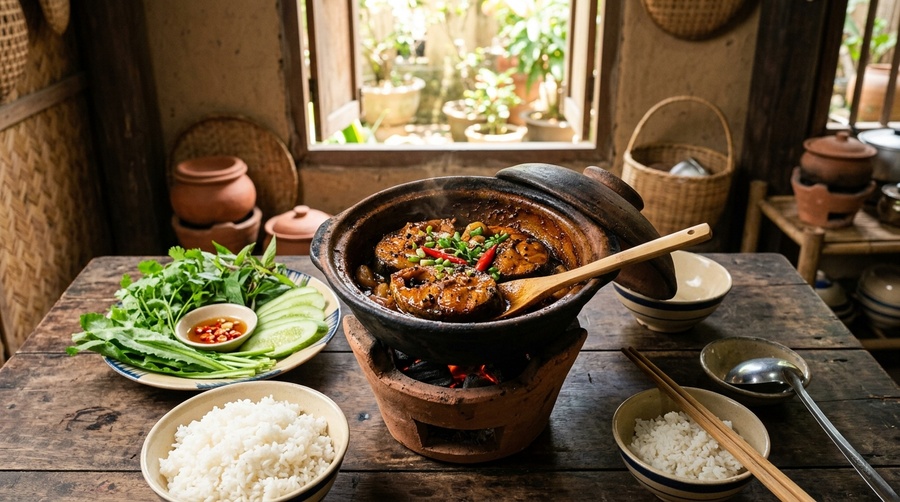
What is cá kho tộ
Cá kho tộ is fish slowly cooked in a small clay pot with caramel sauce and spices.
The dish belongs to the large group of Vietnamese braised dishes known as kho. With this method, ingredients are cooked for a long time in a small amount of liquid until the sauce becomes thick, rich, and almost glazed.
The classic composition includes:
- fish;
- fish sauce;
- sugar or caramel;
- black pepper;
- garlic;
- shallots;
- chili;
- green onions;
- sometimes coconut water.
Cá kho tộ is not a soup. There is little liquid here, and it serves as a concentrated gravy for the rice.
What does the word "kho" mean
The word kho denotes a method of prolonged braising in a small amount of liquid.
With this technique, the dish:
- cooks slowly;
- absorbs the fish sauce and spices;
- acquires a dark color;
- becomes saltier and richer;
- gets coated in a thick caramel glaze.
In Vietnam, the kho method is used to cook not only fish, but also pork, chicken, eggs, tofu, and other products.
What is a tộ clay pot
A tộ is a small, thick-walled clay pot.
It heats up slowly and retains heat for a long time. Because of this, the fish cooks evenly, and the sauce gradually thickens without evaporating too quickly.
The clay pot also helps create a light aroma of baking and caramelization around the edges.
Today, cá kho tộ can also be cooked in a metal pot, but the traditional presentation in earthenware remains part of the dish's identity.
What kind of fish is used
For cá kho tộ, fish with firm flesh that does not fall apart during long simmering is suitable.
Most commonly used:
- catfish;
- snakehead fish;
- carp;
- saltwater fish;
- mackerel;
- tuna;
- fish from the Mekong Delta.
In southern Vietnam, fatty freshwater fish varieties are especially popular.
Catfish
One of the most famous variations is cá kho tộ with catfish.
On the menu you can find:
- cá basa kho tộ;
- cá bông lau kho tộ;
- cá trê kho tộ.
Catfish has tender, fatty meat and absorbs the sweet-and-savory sauce well.
The fat content of the fish helps the dish stay juicy even after long simmering.
Snakehead Fish
Cá lóc kho tộ is prepared with snakehead fish.
This fish has firm white flesh and holds its shape well.
The flavor turns out less fatty than catfish, but with a more pronounced meaty taste.
Mackerel
Cá thu kho tộ is the mackerel version.
Mackerel has firm, fatty flesh and a rich flavor. It is often cooked in large steaks.
This option is especially popular in coastal regions.
Tuna
Cá ngừ kho tộ is prepared with tuna.
Tuna turns out firm and less fatty. To prevent it from drying out, more oil or coconut water may be added to the sauce.
How caramel sauce is made
The flavor base is the caramel sauce known as nước màu.
It is made from sugar heated to a dark amber color, then carefully diluted with water.
Nước màu gives the dish:
- a dark color;
- a slight bitterness;
- sweetness;
- a caramel aroma;
- a glossy glaze.
It is important not to burn the sugar. Caramel that is too dark makes the sauce bitter.
Fish Sauce
The main salty seasoning is nước mắm (fish sauce).
It gives the dish a deep umami flavor and a characteristic aroma.
The amount of fish sauce depends on the recipe. Cá kho tộ is usually saltier than regular stews because it is eaten with a large amount of plain rice.
Coconut Water
Many southern recipes use coconut water, or nước dừa.
It adds a mild sweetness and helps round out the sauce.
Coconut water is especially characteristic of Mekong Delta cuisine, where coconuts are widely available.
It is important not to confuse it with coconut milk. Classic cá kho tộ most often uses transparent coconut water.
Onions and Garlic
The marinade usually includes:
- garlic, tỏi;
- shallots, hành tím;
- green onions, hành lá.
The garlic and shallots are minced and combined with fish sauce, sugar, and pepper.
Green onions are added closer to the end of cooking.
Black Pepper
Black pepper (tiêu) is one of the main spices of the dish.
It is added to the marinade and generously sprinkled over the finished fish before serving.
Pepper enhances the aroma of the caramel and fish sauce, and also makes the flavor warmer and spicier.
Chili
Fresh chili (ớt) can be added whole or sliced.
The dish is not necessarily very spicy. In some recipes, chili is needed more for aroma and color.
For a less spicy version, you can say:
Ít cay — a little spicy.
How the fish is marinated
Before cooking, the fish is cleaned, cut into large pieces, and marinated.
The marinade may include:
- fish sauce;
- sugar;
- garlic;
- shallots;
- black pepper;
- chili;
- caramel sauce;
- a little oil.
The fish is left in the marinade for some time so the meat absorbs the flavor.
You shouldn't keep delicate fish in a salty marinade for too long, otherwise it might become tough.
How cá kho tộ is cooked
The main process looks like this:
- the fish is cleaned and cut;
- marinated with fish sauce and spices;
- caramel sauce is prepared;
- the fish is placed in a clay pot;
- coconut water or a little water is added;
- brought to a boil;
- heat is reduced;
- simmered slowly;
- the fish is periodically basted with sauce;
- cooked until the liquid thickens.
The fish should not be flipped frequently. It can fall apart, so it is better to gently spoon sauce over the top pieces.
What the texture should be
The finished fish should be:
- tender;
- juicy;
- well-saturated with sauce;
- intact (not fallen apart);
- coated in a dark glaze.
The sauce should be thick, but not completely dry. There should be enough of it to spoon over the rice.
If the sauce is too liquid, the dish hasn't reduced enough.
Varieties of cá kho tộ
Cá lóc kho tộ
Cá lóc kho tộ is snakehead fish braised in a clay pot.
This is one of the classic variants of the Mekong Delta.
The fish is firm, moderately fatty, and holds its shape well.
Cá basa kho tộ
Cá basa kho tộ is a dish made with basa fish.
Basa belongs to the catfish family and has tender, fatty flesh.
The sauce turns out especially rich and is well absorbed by the fish.
Cá bông lau kho tộ
Cá bông lau kho tộ is prepared from large river catfish.
This option is considered richer and is often served in large pieces.
Cá trê kho tộ
Cá trê kho tộ is the version with cá trê catfish.
The meat has a distinct flavor. To eliminate any fishy odor, the fish is thoroughly cleaned and rubbed with salt or lime.
Cá thu kho tộ
Cá thu kho tộ is mackerel in caramel sauce.
Large steaks retain their firmness and are well-suited for long braising.
Cá ngừ kho tộ
Cá ngừ kho tộ is tuna in a clay pot.
This version is leaner and firmer.
Other fish varieties
In different regions, other types of local fish are also used.
The name is usually formed simply: the type of fish plus the words kho tộ.
Cá kho tiêu
Cá kho tiêu is fish braised with a large amount of black pepper.
The word tiêu means "pepper".
This version is close to cá kho tộ, but the main emphasis is on the pepper flavor, and a clay pot is not mandatory.
Cá kho nước dừa
Cá kho nước dừa is fish braised in coconut water.
The flavor turns out milder and sweeter.
This version is especially characteristic of southern Vietnam.
Cá kho khóm
Cá kho khóm is fish braised with pineapple.
In the south, pineapple is often called khóm or thơm.
Pineapple adds fruit acidity and sweetness, making the sauce feel less heavy.
Cá kho măng
Cá kho măng is fish braised with bamboo shoots.
The word măng means "bamboo" or "bamboo shoots".
They add a slight sourness and a firm texture.
Cá kho dưa cải
In some regions, fish is braised with local fruits, vegetables, or herbs. Such versions are more typical of home cooking and may not have a single standardized name.
Cá kho without a clay pot
If the dish is cooked in a regular pot, it may simply be called cá kho.
In flavor it can be almost the same, but formally the name cá kho tộ emphasizes specifically the preparation or serving in a clay pot.
Cá kho chay
Cá kho chay is a vegetarian imitation of the dish.
The word chay means "vegetarian" or "vegan/lent".
Real fish is replaced by:
- tofu;
- seitan;
- mushrooms;
- plant-based fish-shaped products.
The sauce is prepared without fish sauce, using soy sauce and plant-based fermented seasoning instead.
What cá kho tộ is served with
White Rice
The main accompaniment is hot white rice, or cơm trắng.
The salty and sweet sauce is specifically designed to be paired with bland rice.
A small piece of fish is usually enough for several spoonfuls of rice.
Vegetable Soup
Cá kho tộ is often served with a light soup called canh.
This can be:
- canh chua (sour soup);
- greens soup;
- winter melon soup;
- pumpkin soup;
- a light vegetable broth.
The soup helps balance the richness and saltiness of the fish.
Fresh and Boiled Vegetables
Alongside the dish, there may be:
- cucumbers;
- herbs;
- boiled vegetables;
- pickled vegetables;
- water spinach;
- mustard greens.
They are eaten between bites of fish and rice.
How to eat cá kho tộ properly
The dish is usually placed in the center of the table and shared among several people.
A convenient order:
- put rice in a small bowl;
- take a piece of fish;
- add a little sauce;
- check for bones;
- eat together with rice;
- alternate with vegetables or soup.
You shouldn't pour too much sauce over the rice all at once. It is very concentrated and salty.
It's best to transfer the fish gently, as it can be tender after long braising.
Should you eat the fish straight from the pot?
In family-style dining, the dish is often eaten from a shared pot, transferring pieces into personal bowls.
In a restaurant, they might serve an individual portion for one person.
You should not touch the clay pot with your hands: it stays hot for a long time.
How to handle bones
In many versions, the fish is cooked with bones and skin.
The bones can be large or small, so the fish needs to be deboned slowly.
Inedible parts are usually left on a separate small plate.
How cá kho tộ differs from cá kho
Cá kho is the general term for braised fish.
Cá kho tộ is a variety prepared or served in a clay pot.
Thus:
- every cá kho tộ is a cá kho;
- not every cá kho is cooked in a tộ;
- cá kho tộ usually has a particularly thick and caramelized sauce.
How cá kho tộ differs from cá chiên
Cá chiên is fried fish.
Differences:
- cá chiên is fried in oil;
- cá kho tộ is slowly simmered;
- fried fish has a crispy crust;
- braised fish is tender and coated in sauce;
- cá kho tộ is usually sweeter and saltier.
How cá kho tộ differs from canh chua cá
Canh chua cá is a sour fish soup.
Cá kho tộ is a concentrated braised dish, while canh chua is a light soup with vegetables and plenty of broth.
They are often served together: the salty caramel fish goes well with the sour soup.
How to order cá kho tộ
On the menu you might encounter the following names:
- cá kho tộ — fish in a clay pot;
- cá lóc kho tộ — with snakehead fish;
- cá basa kho tộ — with basa;
- cá bông lau kho tộ — with river catfish;
- cá trê kho tộ — with catfish;
- cá thu kho tộ — with mackerel;
- cá ngừ kho tộ — with tuna;
- cá kho tiêu — fish with black pepper;
- cá kho nước dừa — fish in coconut water;
- cá kho khóm — fish with pineapple;
- ít cay — a little spicy;
- không cay — not spicy;
- ít ngọt — less sweet;
- ít mặn — less salty;
- thêm cơm — add rice;
- thêm nước kho — add sauce;
- không da — without skin;
- ít tiêu — less pepper.
The phrase một phần cá kho tộ means "one portion of cá kho tộ".
When is the best time to eat cá kho tộ
Cá kho tộ is usually eaten for lunch or dinner.
It is a home-cooked, family meal that is rarely thought of as a light snack.
It is especially well-suited for a shared meal with rice, soup, and vegetables.
In cool or rainy weather, a hot clay pot feels especially comforting, but in southern Vietnam the dish is eaten year-round.
Where is the best place to try cá kho tộ
The dish is widespread throughout Vietnam, but is especially closely tied to the south and the Mekong Delta.
Look for it in:
- family restaurants;
- home-style eateries;
- set-meal lunch cafes;
- Mekong Delta restaurants;
- Ho Chi Minh City;
- Can Tho;
- Ben Tre;
- Ca Mau.
Good cá kho tộ can be recognized by several signs:
- the sauce is dark and glossy;
- the fish retains its shape;
- the meat remains juicy;
- the caramel aroma is not burnt;
- the fish sauce does not overpower the other flavors;
- the pot is served hot;
- there is enough sauce for the rice, but it is not too liquid.
What tourists should keep in mind
Cá kho tộ may contain:
- fish with bones;
- fish sauce;
- a large amount of sugar;
- chili;
- coconut water;
- fish skin and fat.
The dish is usually quite salty and sweet. This is a characteristic feature of the recipe since it is eaten with plain rice.
If you have a fish allergy, the dish is not suitable. Even a vegetarian imitation in a regular restaurant may be prepared near fish products.
Small bones may remain in the fish.
The clay pot retains heat for a long time, so you should not touch it with your bare hands.
Why you should try cá kho tộ
Cá kho tộ is one of the most distinctive home-cooked dishes of southern Vietnam.
It combines tender fish, the deep flavor of fish sauce, caramel sweetness, the aroma of black pepper, and a mild chili kick.
The dish illustrates the principle of a Vietnamese family meal particularly well: a rich main dish served with plenty of rice, a light soup, and fresh vegetables.
For your first introduction, it's best to choose cá lóc kho tộ or the milder cá basa kho tộ. Eat the fish in small pieces with rice and don't add too much sauce all at once.